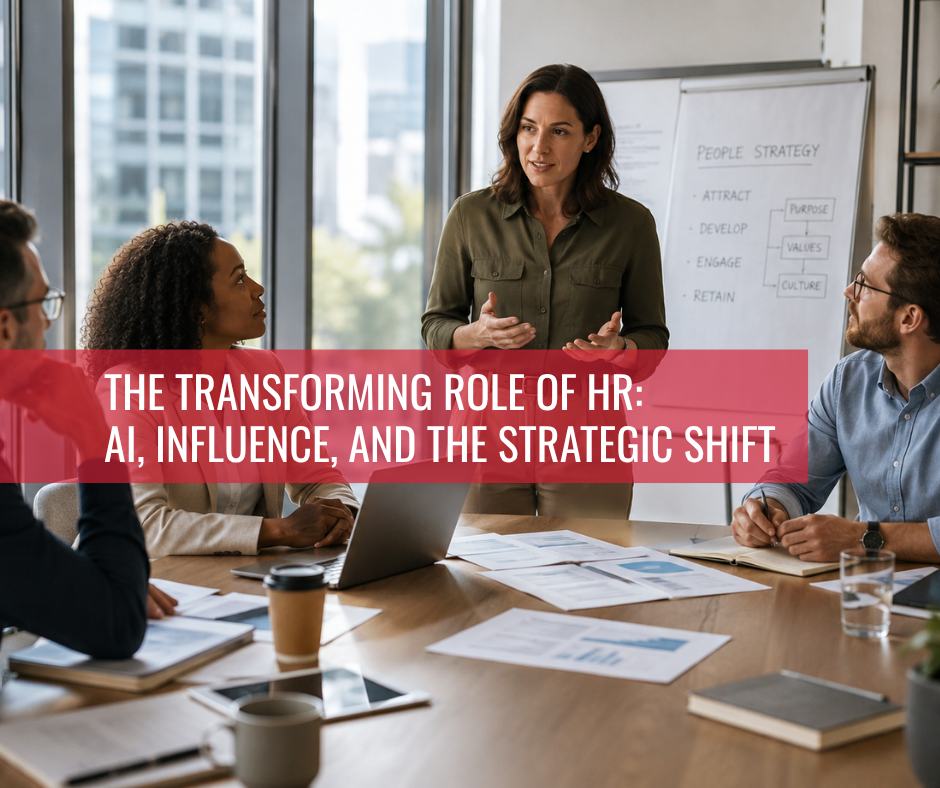
HR is at an inflection point. AI is rewriting the rules — but the real opportunity isn’t about technology. It’s about HR finally having the capacity to do the strategic work it was hired for.
For thirty years, HR has been told it needs to be more strategic. The Ulrich model gave us the architecture — strategic partner, change agent, employee champion, administrative expert — all four, all at once. But in practice, the administrative work never disappeared. We just got busier doing both.
AI changes that. For the first time, HR has the mechanism to genuinely shift the centre of gravity from administration to strategy. The question isn’t whether AI will change HR. It already is. The question is what you do with the capacity it gives back to you.
Every major global challenge lands on HR’s desk
Look at what’s keeping boards awake right now: skills shortages, AI disruption, mental health, culture, psychosocial safety, intergenerational workforce dynamics, hybrid work, retention, leadership capability.
Every one of these is fundamentally a people problem. The board can’t solve them. Finance can’t. Operations can’t. HR can — because HR is the only function sitting at the intersection of all of them.
So the question isn’t whether HR is strategic. It absolutely is. The question is whether you are showing up strategically — and whether the conversations you’re having with your CEO reflect that.
What AI actually does for HR
The honest answer: AI does the first 80% of the work that bores you. You do the last 20% — the judgement, the cultural fit, the legal nuance, the relational read.
Three practical applications worth your attention:
Write and draft. Job ads, policies, position descriptions, communications, frameworks, briefings. AI delivers a usable first draft in under a minute. You bring the organisational context, the cultural lens and the legal review. The capacity unlock is enormous.
Data and insights. This is the strategic tier. HR analytics has moved from descriptive (“here’s what happened”) to predictive (“here’s what’s likely to happen”) to prescriptive (“here’s what to do about it”). Engagement, attrition, capability, workforce planning — AI is turning HR data into board-grade insight. The HR functions that win the next five years will be data-driven, not just data-aware.
Learning and development. AI-personalised learning pathways, tied to workforce capability and business strategy. Not generic compliance modules — actual capability building, matched to the individual and the role.
A caveat that doesn’t get said enough: always review AI output. It doesn’t know your organisation, your culture, your legal obligations or your people. You’re the expert. AI is your very fast assistant — and treating it as anything more than that is where HR functions get into trouble.
Capacity without influence changes nothing
Here’s the trap: AI gives you back time. If you use that time to do more of the same operational work, nothing has changed. The strategic shift requires something else — and it’s the part most HR practitioners find hardest.
It’s influence.
I’ve watched brilliant HR people present excellent ideas to leadership teams and have them quietly die in the room. The pattern is almost never an ideas problem. It’s an influence problem. And it’s completely fixable.
Influence is the outcome of credibility plus trust, over time.
Credibility means being seen as a peer at the leadership table — not as the people person, not as the compliance lead, but as a commercial voice with deep expertise. It starts with one question: do you know your organisation’s single biggest strategic priority? Not an HR priority — a business priority. If you can’t answer that in a sentence, your CEO doesn’t see you as strategic yet. That’s the starting point.
Trust is the slow-burn investment. Same quality, same follow-through, same honesty — every time. One broken promise costs more than ten kept ones. Trust is built in the small, unsexy moments: returning the call, delivering on the date, telling the CEO the thing they don’t want to hear before someone else does.
Influence is what shows up on the other side. It’s when the CEO calls you before making a people decision, not after. It’s when the strategy day invitation arrives without you having to ask for it. It’s when “what does HR think?” becomes a real question, not a courtesy.
The fastest thing you can change is the language you use
The single fastest shift any HR practitioner can make is in the language they use.
Same work, different framing, completely different conversation with leadership.
- “Employee engagement” lands differently than “productivity and discretionary effort.”
- “Wellbeing program” lands differently than “reducing absenteeism and unplanned leave cost.”
- “Training budget” lands differently than “capability investment to deliver the strategic plan.”
- “Culture work” lands differently than “retention of critical talent in a tight market.”
The left column gets a polite nod. The right column gets budget and a seat at the strategy table.
It’s the same work. It’s not spin. It’s translating HR outcomes into the language of the business — and respecting that the people you’re influencing think in commercial terms, not HR terms.
A practical experiment: take your current HR plan, paste it into ChatGPT or Claude, and ask it to “rewrite this in strategic language that resonates with a CEO.” It won’t be perfect. But it’ll shift how you think about the work — and it’ll shift how leadership hears it.
One action, taken consistently, changes everything
The HR functions that thrive over the next five years won’t be the ones with the best technology. They’ll be the ones whose practitioners have made three shifts:
- Used AI to claw back capacity from the administrative tier.
- Reinvested that capacity into credibility and influence at the leadership table.
- Aligned the HR plan to the single biggest business priority — and spoken about it in commercial language.
None of that requires a transformation program. It requires deciding to show up differently.
Pick one HR priority this week. Rewrite it in strategic language. Share it with your CEO. See what happens.
That’s the shift. Strategic HR has never mattered more than right now — and the practitioners willing to step into it will define the function for the next decade.
If you’d like to talk about positioning HR strategically in your organisation — whether that’s an audit, a transformation project, or just a conversation — [book a 30-minute consult with Claire →]

Claire Harrison is the Founder and Managing Director of Harrisons, a flourishing HR consulting business that sprouted in 2009 from Claire’s passionate belief that inspiring leaders and superstar employees are the key success factor to any business. With over 20 years’ experience, Claire has worked as a HR Director of multi-national organisations, as a Non-Executive Board Director, and a small business owner. Claire’s corporate career includes working with companies such as BHP, Westpac, Fonterra and Mayne Nickless.