
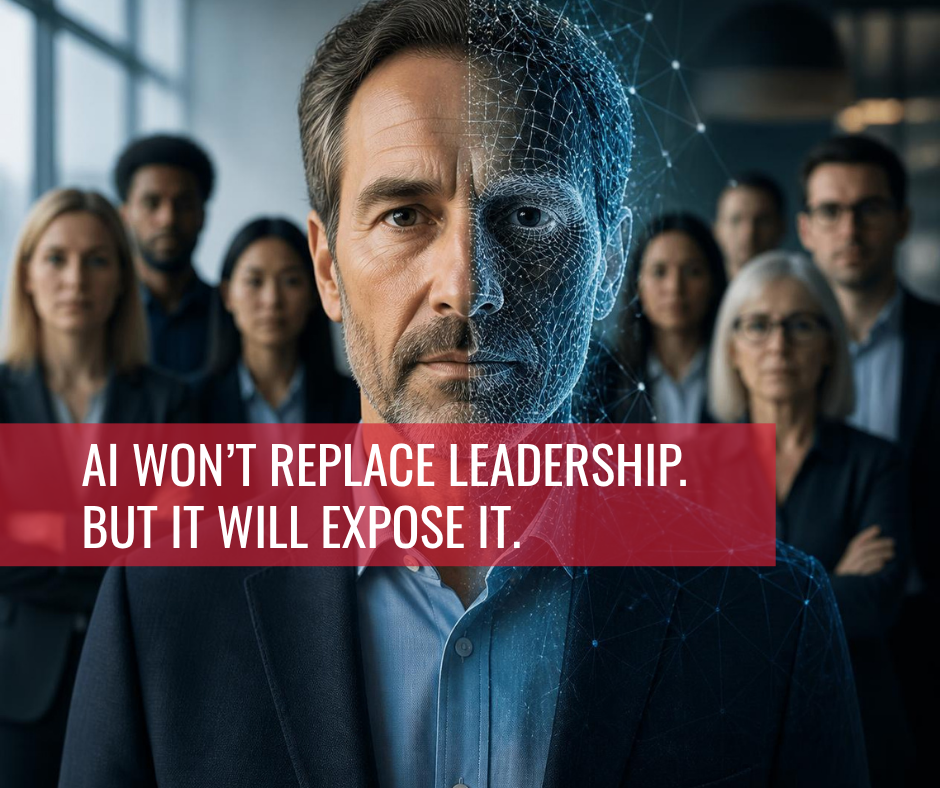
Artificial intelligence is changing the way we work. The bigger question for business leaders is whether their leadership is ready for the change.
Artificial intelligence was understandably one of the major talking points at this year’s AHRI National Convention. There was plenty to discuss: automation, productivity, emerging skills, job design and the rapidly changing nature of work. But the biggest takeaway wasn’t actually about AI. It was about leadership.
Because while technology can change how work gets done, it is leaders who determine how people experience that change. And that distinction matters. For business owners, AI presents an enormous opportunity. It can streamline processes, remove repetitive work and create new ways of delivering value. But if organisations focus solely on the technology, they risk overlooking the people who ultimately determine whether the investment succeeds. The future of work isn’t simply a technology challenge – it’s a leadership challenge.
The real challenge isn’t implementing AI — it’s leading through change
Change has become a constant feature of working life. Businesses are adapting to new technologies, changing customer expectations, skills shortages, economic pressures and increasingly complex workforce needs. Yet the more change employees experience, the more important effective leadership becomes. People don’t necessarily resist change because they are resistant to new ideas. Often, they resist because they don’t understand what the change means for them.
Will my role change?
Will my skills still be relevant?
What will be expected of me?
Will I have the opportunity to learn?
And perhaps most importantly – Where do I fit in the future of this organisation?
These are leadership questions. Introducing AI without addressing them is unlikely to create genuine engagement. Employees need more than an announcement that “AI is coming”. They need context, communication, involvement and confidence that their leaders are thinking about the human impact of change.
Employees don’t just want to feel valued. They want to feel valuable.
One message from the convention particularly resonated with us:
“It’s not enough to feel valued — you also need to feel valuable.”
There is a subtle but powerful difference. Being valued is about recognition. Feeling valuable is about contribution, purpose and capability. People want to know that what they do matters.
They want to see how their role contributes to the success of the business. They want opportunities to develop and to know that they have a future within the organisation. AI makes this conversation even more important. As technology takes over more routine activities, some employees may understandably question where their value lies. The answer shouldn’t simply be reassurance; it should be redesign.
If AI can take care of the repetitive parts of a role, what more meaningful work could that person do?
Could they spend more time with customers?
Could they solve more complex problems?
Could they develop specialist expertise?
Could they mentor others?
Could they contribute to innovation?
The opportunity is not simply to automate jobs. It is to create better jobs.
Curiosity could become one of our most important workplace capabilities
As AI becomes increasingly capable of handling routine and predictable tasks, uniquely human capabilities become more important — critical thinking, judgement, creativity, collaboration, empathy and problem-solving. But these capabilities don’t develop automatically. They require an environment where people are encouraged to ask questions, test ideas and learn. That creates an important responsibility for leaders.
Are your managers creating space for people to be curious?
Can employees suggest a better way of doing something without being dismissed?
Can they experiment without fearing that every mistake will be held against them?
Are managers coaching people to think, rather than simply telling them what to do?
These questions go to the heart of workplace culture. A business cannot tell its people to “be innovative” while maintaining a management style that discourages questions and rewards only compliance. Curiosity needs psychological safety. And that starts with leadership.
We need to stop asking “What can AI do?”
One of the most useful ways to think about AI isn’t to start with the technology. Start with the work. Instead of asking – ‘What can AI do?’, business leaders should be asking:
What are we trying to achieve?
How should the work get done?
Where is the value?
These questions shift the conversation from technology implementation to workforce and job design. This is a much more strategic conversation. AI shouldn’t be introduced simply because it can perform a task.
The better question is whether using AI helps the business achieve something meaningful — better customer outcomes, improved efficiency, greater quality, reduced administrative burden or more rewarding work for employees. Technology should serve the strategy, not the other way around.
What happens to emerging talent?
One area that deserves particular attention is early-career development. Traditionally, entry-level employees have learned by doing. They undertake routine tasks, observe more experienced colleagues, gradually develop their judgement and take on greater responsibility. But what happens when AI performs many of those foundational tasks? If we automate the work through which people traditionally developed their skills, we need to deliberately create new pathways for learning. That could mean more coaching, mentoring, job rotation, structured development programs, project-based learning or greater exposure to customers and complex problem-solving.
We cannot automate the entry point to a career and then wonder where our future leaders will come from. Workforce planning needs to consider not only which roles AI might change, but how the organisation will continue developing its future capability.
The human qualities of leadership haven’t changed
Perhaps the most reassuring message is that the qualities people want from their leaders haven’t fundamentally changed.
Employees still want leaders who are:
- Approachable
- Authentic
- Clear
- Consistent
- Willing to listen
- Interested in their development
- Prepared to have difficult conversations
- Honest about uncertainty
AI doesn’t change these expectations. If anything, it strengthens them. When people are uncertain, they look to their leaders for clarity. When roles are changing, they need someone who will listen. When they are learning something new, they need encouragement. And when the future feels uncertain, they need to trust the people leading them through it.
Culture isn’t an AI project
There’s a temptation to think of workplace culture and technology as two separate conversations. They aren’t. Every significant change in the way people work has cultural implications. If you introduce AI but don’t communicate openly, you may create anxiety. If you encourage experimentation but punish mistakes, people won’t innovate. If you talk about development but don’t provide opportunities to learn, employees will quickly see the disconnect. If you say people are your greatest asset but automate work without considering what happens to their roles, trust will suffer. Culture is created through the consistency between what leaders say and what they do. While technology can support culture, it can’t create it.
What should business leaders be thinking about now?
For Australian business owners and managers, the AI conversation should extend beyond technology.
Consider these questions:
- Do our people understand why we’re changing?
People are more likely to engage with change when they understand the purpose behind it.
- Do employees understand the value they create?
Make the connection between individual contribution, team performance and business success visible.
- Are we redesigning work, or simply automating tasks?
Look for opportunities to remove low-value work while increasing the time people spend on activities that require judgement, creativity and human connection.
- How will our people develop the skills they need?
Don’t leave capability development to chance. Identify the skills your organisation will need and create deliberate pathways to build them.
- Are our managers equipped to lead change?
A technically successful AI implementation can still fail if managers aren’t equipped to communicate, coach and support their teams.
- What does our culture encourage?
If you want curiosity, accountability and innovation, look at the behaviours your leaders currently model and reward.
The opportunity is bigger than AI
The most interesting question about AI isn’t whether it will change work. It will. The more important question is what kind of workplace we choose to create as a result. We can use AI simply to do more with less.
Or we can use it to rethink how work is designed, develop our people differently and create more meaningful opportunities for contribution. That choice sits with leadership.
The organisations that thrive through this period of transformation won’t necessarily be those that adopt the most technology, the fastest. They will be the organisations that understand that technology and people are not competing priorities. They are interconnected. AI may change how work gets done, but leadership determines what that change means for your people. And ultimately, the businesses that get this right won’t just have better technology – they’ll have better work, stronger cultures and people who feel genuinely valuable to the organisation’s future.
Would you like help with implementing AI in your organisation? Building leader capability? Designing work to augment AI in your business? Contact Harrisons.