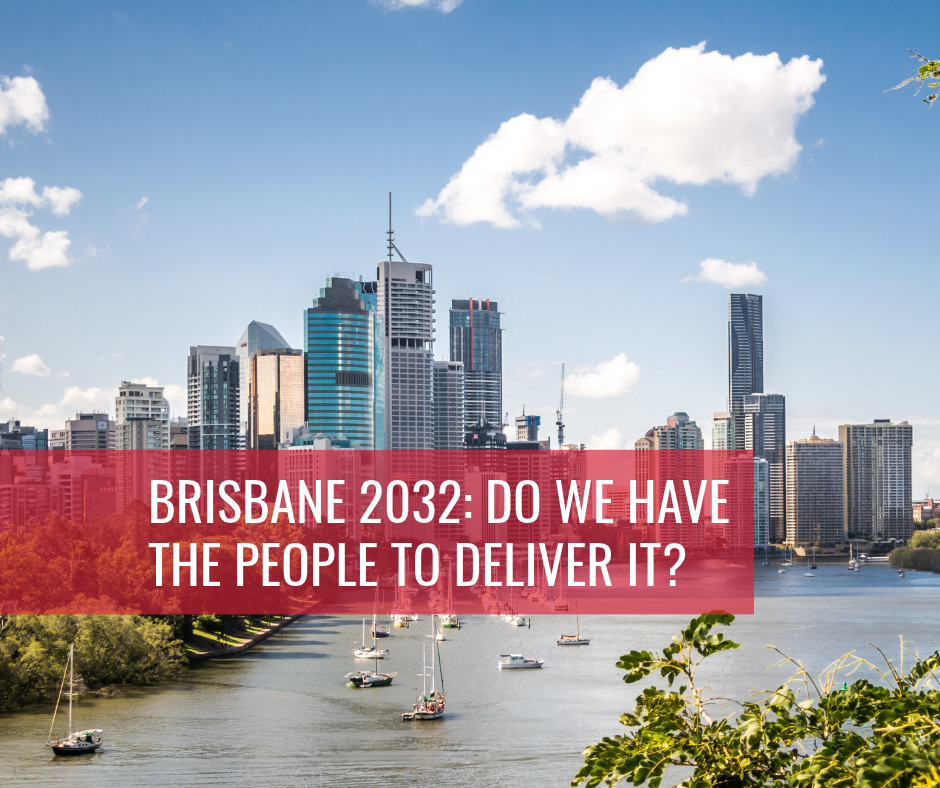
I’m not an Olympics expert. But I’ve spent 30 years helping organisations find, keep and grow people. When I look at 2032, I see a workforce challenge hiding in plain sight.
Six years sounds like plenty of time. It isn’t. An apprentice who starts in 2027 is only just qualified by the time the venues need finishing. A school leaver choosing a course this summer will be in their mid-twenties at the opening ceremony.
Here’s what the research says about the workforce we’ll need before, during and after the Games.
Before the Games: building it
The Queensland Government’s 2032 Delivery Plan commits $7.1 billion to venues, including a 63,000-seat stadium at Victoria Park and a new National Aquatic Centre. Add athlete villages, transport and the Bruce Highway, and the pipeline is enormous.
Construction Skills Queensland’s Horizon 2032 report forecasts:
- an average shortfall of about 19,100 construction workers a year to 2031-32
- a peak shortfall of about 35,000 workers in 2027-28
- Games venues and villages alone needing nearly 8,000 workers at their 2030-31 peak
The pipeline of new workers is going the wrong way. Construction apprentice commencements fell about 30% between 2021-22 and 2024-25. Only 55% of construction trade apprentices complete within six years. Women hold 13% of construction jobs and just 5% of trade roles.
The Queensland Audit Office has warned that Games projects “compete for the same workforce” as every other major project, with shortages in engineering, project management and trades. The Deputy Premier has said the state will “beg, borrow and steal” workers. That’s a frank admission of the gap, but not yet a plan.
During the Games: running it
Previous Games show the scale of the workforce needed for just a few weeks.
- London 2012: about 200,000 people, including staff, volunteers and contractors. More than 250,000 people applied to be one of 70,000 volunteers.
- Paris 2024: 45,000 volunteers from more than 300,000 applicants. Running the Games took around 29,000 full-time equivalent jobs, on top of about 28,000 for infrastructure.
- Sydney 2000: nearly 47,000 volunteers.
- Gold Coast 2018: 15,000 volunteers from 47,000 applications, and an organising committee of about 1,500 paid staff.
Brisbane 2032 is expected to need around 50,000 volunteers. But Queensland’s volunteering rate fell from 75.7% in 2020 to 64.3% in 2023.
The paid workforce matters just as much. London’s security contractor promised 10,400 guards and had about 4,000 ready weeks before the Games, so the military was called in. Paris organisers said private security and catering staff were “a challenge” to recruit. Brisbane will need security, transport, hospitality, cleaning, health and event staff at the same time as tourism peaks.
Tourism already supports one in every 12 Queensland jobs. Industry says the biggest barriers are workforce mobility and access to affordable staff accommodation.
The multiplier: housing
Every workforce plan for 2032 runs into housing.
- Brisbane’s rental vacancy rate was 0.9% in September 2026, with average rents up 7.2% in a year.
- A Greater Brisbane dwelling costs 8.8 times the average income, and a 20% deposit takes almost 12 years to save.
- South East Queensland is expected to grow by 2.2 million people by 2046, needing almost 900,000 new homes and almost one million new jobs.
If the tradies, nurses, chefs and security staff we need can’t afford to live here, we won’t attract them, and we won’t keep the ones we have.
After the Games: keeping the legacy
London showed what’s possible. More than 46,000 people worked on the Olympic Park build, with no work-related fatalities in more than 80 million hours. One in eight had previously been unemployed, and hundreds of apprentices were trained.
Gold Coast 2018 planned for the end from the start, including outplacement support and a virtual careers fair for its workforce.
Queensland’s legacy strategy, Elevate 2042, talks about developing workforce skills and increasing economic participation for First Nations people and people with disability. Those goals need targets, funding and employers on board, now.
What employers can do now
Most of the 2032 workforce won’t work for the Games. They’ll work for builders, councils, hotels, hospitals, transport operators, caterers and small businesses that keep the city running while the Games happen. That means the competition for talent will reach almost every Brisbane employer.
Top 5 tips
- Plan for 2030, not 2032. Map the roles you’ll struggle to fill as construction and Games recruitment peak.
- Grow your own. Apprenticeships, traineeships and graduate programs started now will deliver qualified people in time.
- Widen the pool. Women in trades, mature-age workers, First Nations people and people with disability are under-represented and ready.
- Make it worth staying. Flexibility, leadership and career paths will matter as much as pay when competitors come calling.
- Back volunteering. Let staff volunteer at events between now and 2032. It builds skills and goodwill.
Frequently asked questions
How many volunteers will Brisbane 2032 need? Planning estimates are around 50,000. The organising committee hasn’t confirmed a figure, and roles will be announced after Los Angeles 2028.
How big is the construction workforce gap? Construction Skills Queensland forecasts an average shortfall of about 19,100 workers a year to 2031-32, peaking around 35,000 in 2027-28.
Which other industries will be stretched? Hospitality, tourism, security, transport, health and events, especially during the Games period.
Will the Games affect my business if I’m not involved? Almost certainly, through competition for workers, wage pressure and housing costs.
How Harrisons can help
We help organisations plan their workforce, attract and retain the right people, and develop leaders who keep teams together through change. If you’d like to start planning for 2030 and beyond, get in touch with our team.

Claire Harrison is the Founder and Managing Director of Harrisons, a flourishing HR consulting business that sprouted in 2009 from Claire’s passionate belief that inspiring leaders and superstar employees are the key success factor to any business. With over 20 years’ experience, Claire has worked as a HR Director of multi-national organisations, as a Non-Executive Board Director, and a small business owner. Claire’s corporate career includes working with companies such as BHP, Westpac, Fonterra and Mayne Nickless.