The biggest shift in Australian sexual harassment law is not a new penalty or complaint form. It is a change in who must act, and when.
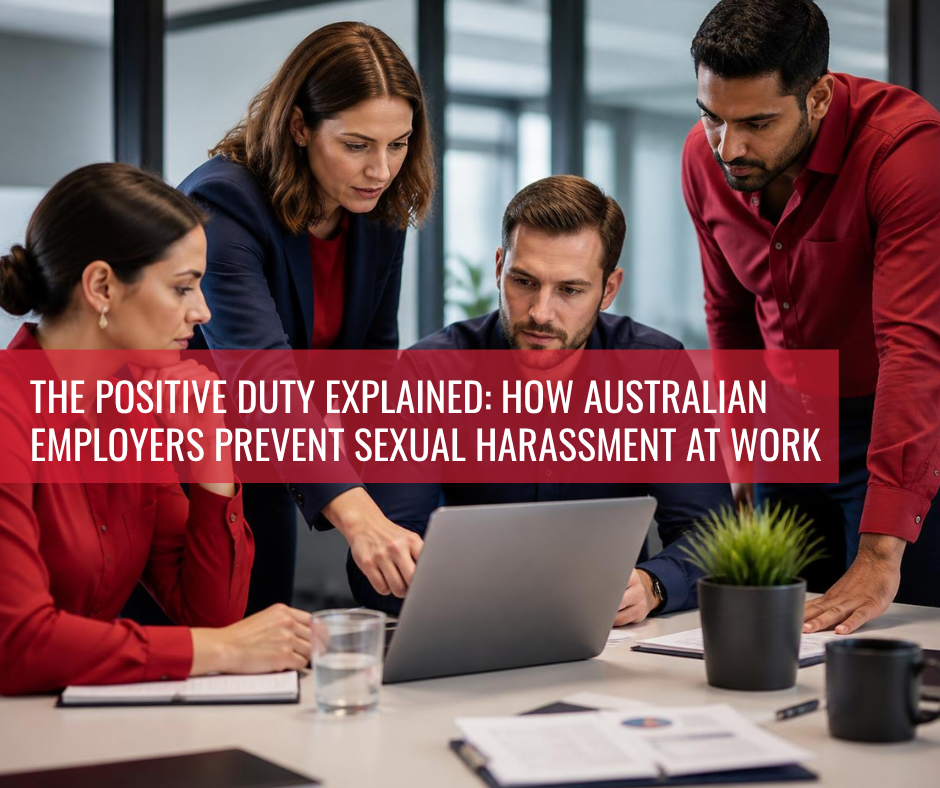
Under the Sex Discrimination Act 1984 (Cth), employers now carry a positive duty — a proactive, ongoing obligation to take reasonable and proportionate measures to eliminate sexual harassment, sex discrimination, sex-based harassment, hostile work environments and victimisation, so far as possible.
You no longer wait for a complaint: you must design the risk out before harm occurs — and prove it. For SME owners, Queensland councils and not-for-profits alike, sexual harassment is now a safety risk to manage like any other hazard.
What’s the real issue?
A policy sitting in a drawer is no longer a defence — and the law now makes that explicit.
- More common than employers assume. One in three Australian workers experienced sexual harassment at work over five years, yet only around 17% ever made a formal report.
- The cost runs to billions a year, most of it borne by employers.
- Risk is highest in male-dominated, hierarchical workplaces and roles with heavy public contact — a profile that fits many councils, front-line services and small businesses.
The old reactive model — wait for a complaint, then respond — no longer works. Regulators expect you to look forward, spot what makes harassment more likely in your workplace, and control it. Our mindset shift for clients: treat it exactly like a safety hazard — risk, control, monitoring.
What this looks like in practice
An anonymised, illustrative composite — not a real person or organisation.
A regional community services organisation had all the right documents — a code of conduct, a policy, an annual online module — and believed it had “covered it”. Over time, a long-serving supervisor developed a pattern of conduct toward younger staff: comments about appearances, “jokes” with a sexual edge, lingering one-on-one late shifts. Workers were uncomfortable, but none complained — some feared for their shifts, others assumed nothing would change. It surfaced only when a valued employee resigned and explained why.
The signs had been there. What was missing was not a policy, but any system for seeing the risk: no trusted reporting channel, no manager trained to interrupt the conduct, no review of higher-risk shifts — the exact gap the positive duty is meant to close.
What does the law say — and how must it be applied?
The definition and the duty
Sexual harassment is unwelcome conduct of a sexual nature where a reasonable person would have anticipated the possibility the person harassed would feel offended, humiliated or intimidated. It is a deliberately low, objective threshold — “meant as a joke”, after hours or alcohol-fuelled is beside the point.
The positive duty, in force since December 2022, requires employers and PCBUs to take reasonable and proportionate measures to eliminate the conduct so far as possible — scaled to your size, nature and resources, but always deliberate and ongoing. Since December 2023, the Australian Human Rights Commission (AHRC) can enforce it, including compliance notices, enforceable undertakings and Federal Court orders.
The AHRC’s seven standards
- Leadership — senior leaders understand the duty and are visibly accountable.
- Culture — a safe, respectful, inclusive workplace.
- Knowledge — everyone knows the expected standards, rights and responsibilities.
- Risk management — harassment treated as a health and safety risk to identify and control.
- Support — available to workers whether or not they report.
- Reporting and response — trusted avenues, and consistent, fair responses.
- Monitoring and transparency — checking measures work, and adjusting.
Other avenues and layers
- Fair Work Commission. The FWC can make “stop sexual harassment” orders, and deal with a sexual harassment dispute brought by a worker or union — issuing, if unresolved, a certificate to take the matter to court for compensation and penalties.
- Vicarious liability. Employers answer for a worker’s conduct unless they took all reasonable steps to prevent it.
- Work health and safety. Sexual harassment is a recognised psychosocial hazard; under WHS laws PCBUs must, so far as reasonably practicable, protect workers’ psychological health.
- Queensland prevention plans. From 1 March 2025, Queensland PCBUs must manage the risk and, where controls are needed, implement a written sexual harassment prevention plan (SHPP).
- NDA restrictions in Victoria. The Restricting Non-Disclosure Agreements (Sexual Harassment) Act 2025 (Vic), from 1 July 2026, limits NDAs in these matters — treat confidentiality clauses with caution.
What are the risks and pain points for employers?
- Action on multiple fronts — SD Act claims, FWC disputes and stop-orders, WHS enforcement, and AHRC action on the duty itself even where nobody has complained.
- The “we had a policy” trap — our most common finding: a document without training, trusted reporting, risk assessment and monitoring neither satisfies the duty nor prevents harm.
- Underreporting — most incidents are never reported, so an absence of complaints tells you nothing about whether you are safe.
- People and reputation — lost staff, damaged trust and reputational harm can far exceed any legal remedy, and obligations now differ across Commonwealth, WHS, Queensland and Victorian requirements.
Our top five tips: what every employer should do
- Treat it as a safety risk — assess and control it. Sit sexual harassment alongside your other psychosocial hazards. Identify the risk factors in your workplace — isolated or late shifts, power imbalances, alcohol at work events, heavy public contact — put controls in place, and document the assessment. In Queensland, build this into a written prevention plan.
- Make leadership visible and accountable. The standard leaders walk past is the standard they accept. Ensure senior people understand the duty, model respectful behaviour and are measured on it — prevention only sticks when accountability sits at the top and flows down through managers.
- Build reporting people actually trust — and offer support regardless. Provide multiple, accessible avenues to raise concerns, including a confidential (and where practical, anonymous) channel, and respond consistently and with procedural fairness. Offer support such as an EAP whether or not someone complains, and protect people from victimisation for speaking up or being a bystander.
- Train for behaviour, not just compliance. Move beyond the annual click-through module. Deliver role-relevant training that helps workers recognise the conduct, empowers bystanders to intervene safely, and equips managers to interrupt problems early — reinforced through induction and everyday practice.
- Monitor, evaluate and adjust. A policy alone is not enough — check whether your controls work. Use culture and exit surveys, track trends, review higher-risk situations, and report to your board. Then close the loop and change what isn’t working. This is what most distinguishes real compliance from paperwork.
Frequently asked questions
- What is the positive duty, in plain terms?
A legal obligation on employers to take reasonable and proportionate steps to prevent sexual harassment, sex discrimination, sex-based harassment, hostile work environments and victimisation before they happen, so far as possible. It has applied under the Sex Discrimination Act since December 2022 and shifts the burden from victims complaining to employers acting.
- Is having a sexual harassment policy enough to comply?
No. A policy is a starting point, not compliance. The duty requires you to assess risk, put controls in place, train people, provide trusted reporting and support, and monitor whether it is working. A document with none of that behind it will neither meet the duty nor protect anyone.
- Does it apply to small businesses and not-for-profits?
Yes — it applies to all employers and PCBUs. What is “reasonable and proportionate” is scaled to your size, resources and circumstances, but every organisation must take genuine, ongoing steps. In Queensland specifically, since 1 March 2025 PCBUs must, where controls are needed, implement a written sexual harassment prevention plan (SHPP); elsewhere, a documented plan is still a practical way to demonstrate compliance.
- What is a “stop sexual harassment” order?
An order the Fair Work Commission can make — like a stop-bullying order — where a worker has been harassed and there is a risk it will continue; it focuses on stopping the behaviour, not compensation. Separately, the FWC can deal with sexual harassment disputes and, if unresolved, issue a certificate allowing the matter to proceed to court.
- Can our organisation be liable for something a worker did — and must we act without a complaint?
Yes on both. Employers can be vicariously liable for sexual harassment by their workers or agents unless they took all reasonable steps to prevent it. And you can — and sometimes should — investigate conduct you become aware of even without a formal complaint; given how low reporting rates are, no complaint does not mean no risk.
How Harrisons can help
Getting the positive duty wrong is costly — regulator action, court claims, lost people and reputational damage, often before a single complaint is filed. Getting it right is a system, not a document — and that is what we build with clients:
- Positive-duty gap assessments against the AHRC’s seven standards
- Psychosocial risk assessments and Queensland sexual harassment prevention plans (SHPPs)
- Behaviour-focused policies and trusted reporting frameworks
- Leadership, manager and bystander training that changes conduct, not just ticks a box
Don’t wait for a complaint to find the gap. Get in touch with our team today and start with a positive-duty gap assessment — a clear, practical picture of where you stand and what to do next.
This article is general information, not legal advice. Laws here are evolving and vary between jurisdictions — seek advice for your circumstances before acting.

Claire Harrison is the Founder and Managing Director of Harrisons, a flourishing HR consulting business that sprouted in 2009 from Claire’s passionate belief that inspiring leaders and superstar employees are the key success factor to any business. With over 20 years’ experience, Claire has worked as a HR Director of multi-national organisations, as a Non-Executive Board Director, and a small business owner. Claire’s corporate career includes working with companies such as BHP, Westpac, Fonterra and Mayne Nickless.