Last night I attended the QUT School of Management Industry Forum 2026 – Making AI Work in Organisations: Evidence, Capability and Leadership.
The opening speaker was Professor Marek Kowalkiewicz, who spoke about how artificial intelligence is reshaping professions. His presentation centred on an idea that has stayed with me since: the “Job Split.”
It’s a deceptively simple concept, but one that has significant implications for many professions — including HR.
“Half your job was never really your job”
Marek shared a story about a lawyer friend who had just discovered AI could review contracts in seconds and was worried he might become obsolete.
Marek responded with a simple question:
“Why do you think they hired you?”
The lawyer initially answered: “To review contracts.”
But that’s not the real reason.
Clients hire lawyers to protect them from risk, to navigate complex decisions, and to ensure they avoid catastrophic mistakes. Reviewing contracts is simply the method.
This distinction sits at the heart of Marek’s argument.
Most professions confuse tasks with outcomes.
Organisations and clients rarely hire professionals for the tasks they perform. They hire them for the outcomes those tasks enable.
And this is where AI begins to reshape work.
The “Job Split” framework
Marek described AI as creating a split within professions across four dimensions:
Drop – tasks that AI will increasingly absorb
Defend– the human capabilities that remain essential
Elevate– how the profession shifts toward higher-value work
Reinvent – entirely new roles that emerge
AI is incredibly good at tasks — analysing data, processing documents, generating reports, identifying patterns. But the human value of most professions sits somewhere else entirely: in judgement, relationships, ethics, creativity, and trust.
Listening to Marek speak, I found myself reflecting on what this means for HR professionals. Because HR is a profession that has long been defined — sometimes unfairly — by its tasks Policies. Forms. Compliance documentation. Recruitment administration. Reporting. Engagement surveys.
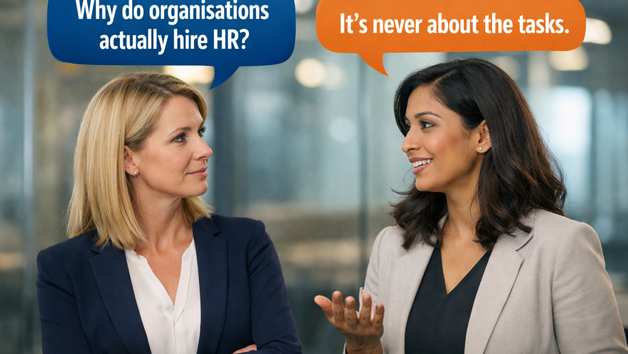
But if we apply Marek’s question to HR — “Why do organisations actually hire HR?” — the answer becomes clearer.
Organisations do not hire HR to write policies. They hire HR to help organisations work through people.
To help leaders navigate complex employee issues. To build cultures where employees can perform and stay. To manage risk when human dynamics become complicated. To support leaders in making better people decisions.
In short, the real job of HR is organisational health and human performance. The policies and processes are simply tools.
Applying the Job Split to HR
If we apply Marek’s framework to the HR profession, a clear pattern begins to emerge.
Drop – administrative HR tasks
Many traditional HR activities are structured and therefore increasingly automatable:
- drafting policies and employment documentation
- analysing engagement surveys and workforce data
- screening CVs and sourcing candidates
- answering routine HR queries
- generating workforce reports
- managing HR records and documentation
These activities consume a large portion of HR teams’ time today. But they were never the real value of the profession.
Defend – the human core of HR
The work organisations truly rely on HR for is much more human. This includes:
- navigating complex employee relations issues
- supporting leaders through difficult conversations
- mediating conflict and rebuilding trust
- addressing psychosocial hazards and workplace wellbeing
- interpreting situations where policies alone don’t provide answers
- making ethical decisions in ambiguous circumstances
These situations require context, judgement, empathy and trust — capabilities that remain deeply human.
Elevate – from process managers to organisational advisors
If AI reduces the administrative workload, HR professionals have an opportunity to focus on work that more directly influences organisational performance. This includes:
- coaching leaders to build stronger teams
- advising executives on workforce strategy
- designing cultures that support engagement and productivity
- identifying emerging people risks before they escalate
- helping organisations adapt to changing workforce expectations
In this sense, HR shifts from process manager to organisational advisor.
Reinvent – new roles emerging
We are also likely to see new roles emerge where people expertise intersects with AI capability, such as:
- Workforce Intelligence Strategists using AI-driven insights to anticipate talent and capability needs
- Organisational Health Architects designing systems that support wellbeing, engagement and productivity
- Human-AI Workplace Integrators helping organisations redesign jobs and workflows as AI becomes embedded
- Psychosocial Risk Strategists focusing on leadership behaviours, organisational design and workplace mental health
A moment of reflection for the HR profession
One of the most powerful insights from Marek’s presentation was this:
AI isn’t removing the value of professions. It is revealing their true purpose.
By stripping away repetitive tasks, AI forces us to confront a deeper question:
What is the real value we bring?
For HR professionals, the answer has never been administration. It has always been about helping organisations succeed through people.
- Supporting leaders.
- Navigating complex human dynamics.
- Protecting organisational culture.
- Managing people-related risk.
These are deeply human challenges. And they are unlikely to disappear.
The opportunity ahead
The future of HR will almost certainly look different from the past.
But that doesn’t mean the profession becomes less relevant. If anything, the opposite may be true.
As work becomes more complex and technology becomes more embedded in organisations, the need for professionals who can navigate human complexity, build trust, and guide leaders through uncertainty may only grow.
Prof. Marek Kowalkiewicz of QUT (Queensland University of Technology) Business School left us with a metaphor that I think captures this perfectly.
AI is like a pencil sharpener.
It removes the outer wood — the tasks and processes — leaving the graphite core. Sharper. More focused. More capable of doing the job it was always meant to do.
For HR, that core has always been about people, judgement, relationships and organisational health.
The question for the profession now is this:
Will we embrace that sharper focus — or continue trying to hold on to the wood shavings?

Claire Harrison is the Founder and Managing Director of Harrisons, a flourishing HR consulting business that sprouted in 2009 from Claire’s passionate belief that inspiring leaders and superstar employees are the key success factor to any business. With over 20 years’ experience, Claire has worked as a HR Director of multi-national organisations, as a Non-Executive Board Director, and a small business owner. Claire’s corporate career includes working with companies such as BHP, Westpac, Fonterra and Mayne Nickless.