Every organisation is at a different stage with AI. Some are experimenting with ChatGPT. Others are building agent workflows. But most are still asking the same fundamental question: where does AI actually fit into our work?
The answer isn’t about replacing people. It’s about rethinking how work gets done across a team, a department, or an entire function.
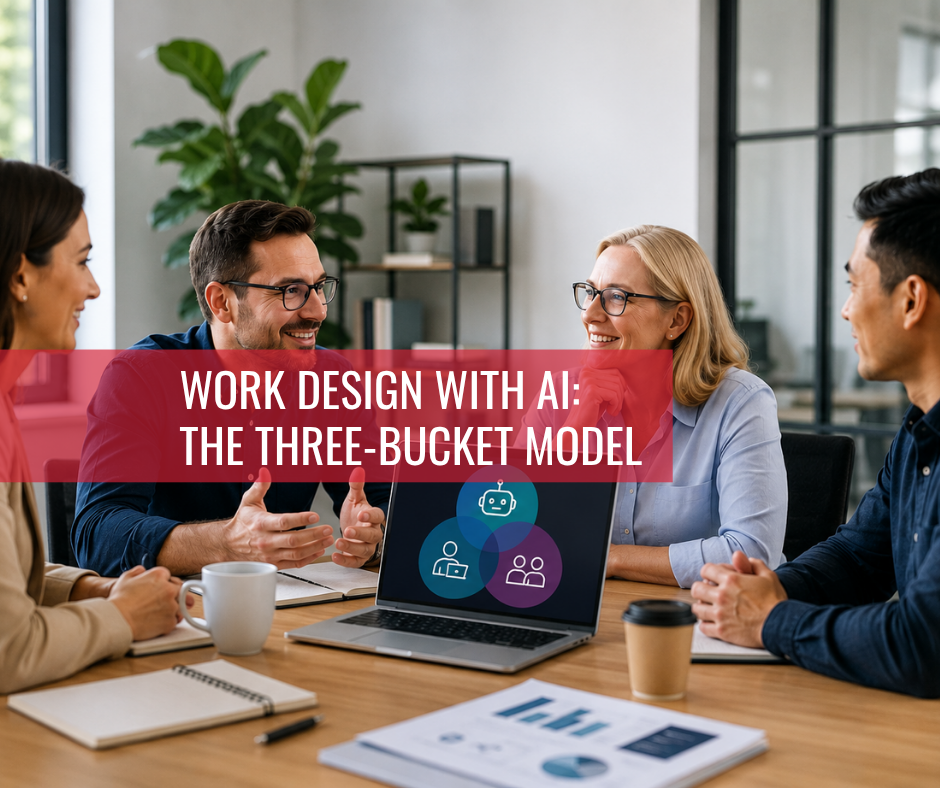
At Harrisons, we work with clients using a three-bucket framework for work redesign. Instead of looking at individual jobs in isolation, we map all the tasks that happen in a department—the interviews, the admin, the analysis, the coaching—and sort them into three categories. This gives you a clear picture of where AI creates value and where the human element is irreplaceable.
The Three Bucket Model of AI Adoption
Automation
Work that can be completely done by AI and agents, with no human involvement needed.
HR example:
First-level support. An AI agent or chatbot handles routine inquiries about entitlements, policy, and leave—fully automated, no handoff required.
Augmentation
Work done by humans that AI makes better: faster, more efficient, higher value.
HR example:
Position descriptions. You interview the manager or role holder to capture nuance and context. AI then drafts the full position description from a template and your conversation notes—saving hours of writing work.
Human-Centric
Work that must remain with people. The relationship, judgment, and presence are what matter.
HR example:
Coaching, leadership development, and performance conversations. These require human judgment, empathy, and face-to-face connection. AI doesn’t belong here.
Why team/department-level redesign matters
Most AI conversations focus on individual jobs or tasks. But that’s too narrow. When you map work at the department/team level, you see something different: workflows, handoffs, dependencies, and bottlenecks that individual job analysis misses.
You also see where AI creates real savings—not just time shaving, but actual capacity. If your HR team spends 20% of their time on routine support queries that can be fully automated, you’ve just freed up headspace for higher-value work: strategy, culture, development.
The key question for your organisation
Once you’ve sorted work into the three buckets, the real redesign begins:
Automation: What’s the implementation cost? Who owns the setup?
Augmentation: Which tools, agents or prompts will your team actually use? What training and governance do you need?
Human-centric: How do you protect this work from automation pressure? What new skills does your team need?
The organisations getting this right aren’t the ones that automate everything. They’re the ones that are intentional about what stays human and why.
Where to start
Pick a team or department. Map every major task, activity, or workflow that happens. Then sort each one into a bucket.
You’ll quickly see patterns. You’ll spot dependencies you didn’t know existed. And you’ll start to see where AI genuinely creates value—and where it would just be a distraction.
If you’d like to work through this process with a team that understands both the HR and organisational design sides of this work, we’d like to help. Get in touch with Harrisons and we can discuss what a work redesign review looks like for your organisation.