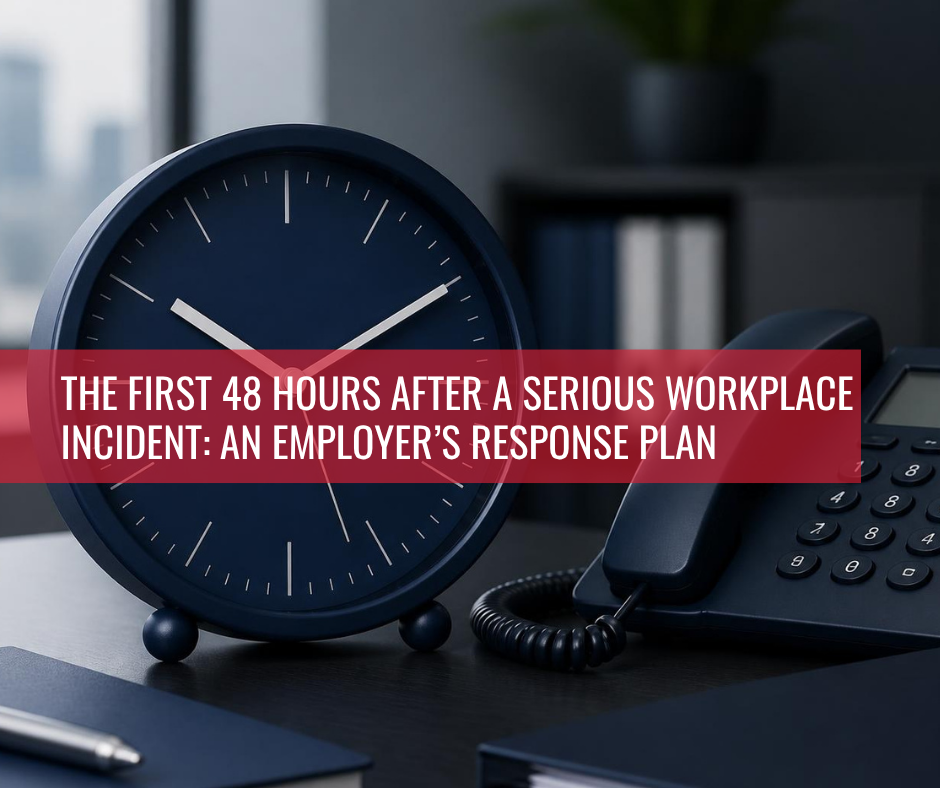
When a worker is killed or seriously injured at work, the first 48 hours shape everything that follows — your legal exposure, your standing with the WHS regulator, the wellbeing of your people, and your ability to defend any future prosecution. The best predictor of a good response is having an incident-response plan ready before anything happens.
Here is what Australian employers — SME owners, Queensland councils and not-for-profits — should do when the worst occurs.
What’s the real issue?
A serious incident forces you to protect your people, deal with the regulator and shield the organisation all at once — with no time to think. These calls must be made in advance, not on the day.
A serious incident is a notifiable incident under WHS law: a death, a serious injury or illness, or a dangerous incident (a serious near-miss). The stakes are high — industrial manslaughter now carries up to 20 years’ imprisonment for individuals and multi-million-dollar fines for organisations in Queensland and most jurisdictions.
Your first 48 hours at a glance
- Make the scene safe and help the injured — then leave it untouched
- Notify the WHS regulator immediately — known facts only
- Call your lawyers and establish privilege before any investigation begins
- Support your people with a trained carer and prompt counselling
- Channel all communications through one authorised person
What this looks like in practice
An anonymised composite: a civil works crew is finishing up when a piece of plant fails and a long-serving worker is fatally injured.
- Handled badly: the scene is tidied, the plant moved, a manager emails the team guessing at the cause. Days later the regulator finds a disturbed site — and those emails are discoverable evidence.
- Handled well: the scene is made safe but untouched, one manager handles the inspector, the lawyers are called that evening, and all messaging runs through one authorised person.
The difference is preparation, not luck.
What does the law say?
WHS law imposes obligations that bite immediately.
- Notify the regulator immediately. Under the model Work Health and Safety Act (in Queensland, the Work Health and Safety Act 2011 (Qld)), a PCBU must notify as soon as it becomes aware of a notifiable incident. Failing to notify is itself an offence.
- Preserve the site until an inspector arrives or directs — you may only help the injured, make it safe, or prevent a further incident. Collect perishable CCTV promptly; it is often overwritten within days.
- Industrial manslaughter is real law. In Queensland’s first conviction of an employer, a contractor was fined $7 million plus costs after a jury found it caused a worker’s death through criminal negligence. It captures organisations and their officers, who can face personal criminal liability.
- Individuals have protections. A person keeps the privilege against self-incrimination and the right to legal advice before answering an inspector; organisations do not — so advice must come early.
What are the risks for employers?
- Losing legal professional privilege — it applies only where the dominant purpose is legal advice or litigation, and once lost is gone forever.
- Self-inflicted evidence — speculative emails and texts about cause or blame are discoverable and can be made public.
- Disturbing the scene — well-meaning clean-ups breach the preservation duty and destroy evidence.
- Neglecting psychological harm — witnesses and co-workers can be badly affected; a welfare and, increasingly, a compliance failure.
- Personal exposure for officers — their interests and the organisation’s may diverge, so they may need separate advice.
- No plan — deciding it all for the first time on your organisation’s worst day.
Our top five tips: what every employer should do
- Build an incident-response plan before you need it. Document the notification chain, name the single points of contact for emergency services and the regulator, pre-identify your lawyers, PR support and an Employee Assistance Programme or psychologist, and rehearse it. When an incident occurs you should be executing a plan, not inventing one.
- Make the scene safe, then leave it alone — and notify immediately. Address any ongoing danger, help the injured, then preserve the site until an inspector arrives or directs otherwise. Notify the WHS regulator straight away with the known facts only. Appoint one nominated person to speak to emergency services and the regulator — cooperative and responsive, but not commenting on cause or fault.
- Call your lawyers first, and establish privilege from the outset. Engage legal advisers early and have them commission any investigation in writing, for the dominant purpose of legal advice and anticipated litigation. Mark privileged material “Privileged and Confidential”, store it in a restricted location, and share it strictly on a need-to-know basis. Remember privilege runs separately from — and does not replace — your business-as-usual safety investigation.
- Put people first with a real pastoral-care plan. Provide psychological first aid as promptly as physical first aid. Designate a trained support person — separate from anyone collecting evidence — to look after the injured person, witnesses, co-workers and families. Offer counselling, EAP access and regular check-ins, and address practical needs like transport and finances early.
- Control communications through one authorised channel. Appoint a single point of management for all external communications, brief staff not to comment, keep every message factual and free of speculation, and pause any routine document-destruction practices (a litigation hold). Assume every record you create could one day be public.
Frequently asked questions
- What counts as a notifiable incident?
A death, a serious injury or illness, or a dangerous incident (a serious near-miss). If in doubt, treat it as notifiable and seek advice — failing to notify is itself an offence.
- How quickly must I notify the WHS regulator?
Immediately after you become aware a notifiable incident has occurred. This can be by phone or in writing, and the regulator may then require a written notification. Provide the known facts only.
- Can I clean up or move things after an incident?
No — you must preserve the site until an inspector arrives or directs otherwise. The only permitted actions are to help an injured person, make the site safe, or prevent a further incident. Do collect perishable evidence like CCTV promptly, as it is often overwritten.
- What is legal professional privilege and why does it matter so much?
It keeps confidential legal communications out of court proceedings and regulator investigations — but only where giving or obtaining legal advice (or preparing for litigation) is the dominant purpose. It must be established from the outset, and once lost it cannot be recovered.
- Do I have to answer everything an inspector asks?
Individuals have a right to legal advice and, generally, a privilege against self-incrimination. Ask the inspector to confirm the powers being exercised, request time for legal advice, and — when compelled — answer honestly, from first-hand knowledge, only the question asked.
- What is industrial manslaughter and could it apply to me?
A criminal offence, now law in Queensland and most Australian jurisdictions, for conduct that causes a worker’s death through negligence or recklessness. It applies to organisations and their officers, with penalties up to 20 years’ imprisonment for individuals and multi-million-dollar fines for organisations.
- Should our officers get their own lawyer?
Often, yes. The interests of the organisation and an individual officer can diverge, so independent advice for officers and managers is prudent where personal exposure exists.
- We’re a small council / not-for-profit — is this really for us?
Yes. WHS duties and industrial manslaughter laws apply regardless of size or sector. Smaller organisations are often the least prepared, which is exactly why an incident-response plan matters most for you.
How Harrisons can help
Get the first 48 hours wrong and the cost is measured in prosecutions, personal liability for your officers, and lasting harm to your people. Get it right and you protect all three. We help Australian employers — SMEs, Queensland councils and not-for-profits — do exactly that. We can:
- Build your incident-response plan and run a readiness review before anything happens
- Clarify your notification obligations and set up your single points of contact
- Coordinate the right experts — legal, communications and psychological support
Don’t wait for the worst day to find out whether you’re ready. Get in touch with our team today and let’s start with an incident-response plan and readiness review.
This article is general information only and not legal advice. Specific legal advice should always be sought for any particular incident.

Claire Harrison is the Founder and Managing Director of Harrisons, a flourishing HR consulting business that sprouted in 2009 from Claire’s passionate belief that inspiring leaders and superstar employees are the key success factor to any business. With over 20 years’ experience, Claire has worked as a HR Director of multi-national organisations, as a Non-Executive Board Director, and a small business owner. Claire’s corporate career includes working with companies such as BHP, Westpac, Fonterra and Mayne Nickless.