Performance-manage an underperformer, restructure a team or investigate a bullying complaint, and you are no longer working within employment law alone. That decision now sits inside your work health and safety duty — and a process that is perfectly lawful under the Fair Work Act can still expose you under WHS legislation.
The answer is not to stop making decisions. It is to make them with a documented risk management plan.
What’s the real issue?
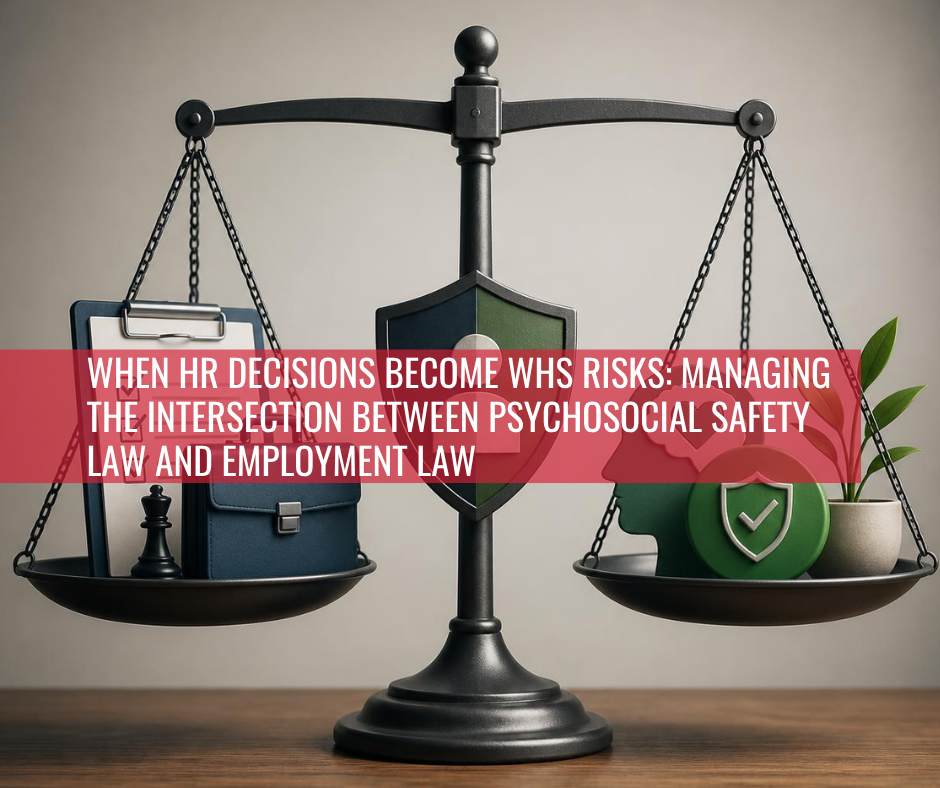
The real issue is simple: a lawful HR decision can still be an unsafe one. The same decision faces two tests:
- Employment law asks: was there a valid reason, and was procedural fairness afforded?
- WHS law asks: were the foreseeable risks to psychological health identified and controlled?
Under the Work Health and Safety Act 2011 (Cth), “health” includes psychological health (s 4), and the primary duty of care (s 19) reaches into performance management, discipline, restructures and investigations. Lawful does not always mean safe — and regulators no longer wait for injury.
What this looks like in practice
Consider a mid-sized Queensland organisation — a composite of matters we have advised on. Under budget pressure, the executive merged two departments and changed reporting lines. At the same time, one affected employee was on a performance plan, and a bullying complaint had just been lodged. Each was defensible — but they landed on the same people at once:
- Staff learned of the changes through corridor rumour.
- The investigation dragged on with no timeline and no updates.
- The employee on the plan assumed their role change was connected.
Sick leave rose; a stress claim followed. The regulator asked not “was the restructure lawful?” but “what did you do to control the risk to these workers’ psychological health — and can you show us?” No document answered it. That is where most employers are exposed.
What does the law say?
The core duty. Identify reasonably foreseeable hazards, eliminate or minimise the risk so far as is reasonably practicable, then review your controls (regs 34–38, Work Health and Safety Regulations 2011 (Cth)). Regulation 55A defines a psychosocial hazard as one arising from the design or management of work, the work environment, workplace interactions or behaviours that may cause psychological harm.
Organisational justice counts. Safe Work Australia’s Model Code of Practice: Managing Psychosocial Hazards at Work lists the hazards employers create through ordinary management — high job demands, low role clarity, poor change management, poor organisational justice, inadequate support, bullying and conflict. A poorly handled process creates exposure even where the decision is lawful.
Consult widely. Sections 47–49 require you to consult workers likely to be directly affected — including award-free and senior staff who may have no contractual right, because the WHS duty attaches to exposure, not industrial coverage. Victoria runs a parallel regime under its Occupational Health and Safety (Psychological Health) Regulations 2025.
Regulators are acting. In December 2025 a Commonwealth agency was convicted and fined $188,000 under s 33 after failing to protect a worker in visible distress during performance management. Regulators examine systems, timing and safeguards — not just the outcome.
What are the risks for employers?
- Convergence. One bullying complaint can engage WHS duties, employment law, discrimination law and workers’ compensation at once. A “reasonable management action” defence (s 11A, Workers Compensation Act 1987 (NSW); s 40, Workplace Injury Rehabilitation and Compensation Act 2013 (Vic)) may bar a compensation claim but does not decide whether you have met your WHS duty.
- Personal liability. Managers and HR practitioners are usually workers under s 28, who must take reasonable care — so their acts and omissions carry personal consequences.
- Over-correction. Do not let anxiety about risk delay restructures or hard conversations. Avoiding good business decisions is not compliance — it is paralysis. Manage the risk with a plan; do not avoid the decision.
Our top five tips: what every employer should do
- Keep a documented psychosocial risk management plan for every significant people process. Before a performance process, restructure, discipline or investigation, write down the foreseeable psychological hazards, the controls you will apply, how you will consult and when you will review. If it is not documented, to a regulator it did not happen.
- Consult early and widely — including workers no instrument covers. Consult those directly affected under sections 47–49 as changes are being shaped, not announced, and treat reporting-line changes and process uncertainty as hazards in their own right. Extend consultation to award-free and senior staff even where no award, agreement or contract requires it.
- Give a realistic timeline and steady updates during investigations. Tell people up front that an investigation may take up to around three months, and provide regular updates — not necessarily weekly, but silence is itself a hazard. Build in safeguards against delay, which is exactly what regulators have penalised.
- Make sure the system of work is followed, not just written. A risk matrix that sits in a drawer is worthless. Train managers in your psychosocial risk process, consult employees on the system of work applied to them, and verify in practice that the controls are operating.
- Do not let risk aversion stop good decisions — manage the risk instead. Keep managing performance and driving necessary change. The lawful, safe path is the well-planned one: identify the risk, control it, document it, and proceed.
Frequently asked questions
- Can a lawful HR decision still breach WHS law?
Yes. Employment law asks whether a decision was valid and fair; WHS law asks whether foreseeable risks to psychological health were identified and controlled. A restructure or performance process can satisfy the Fair Work Act and still leave unmanaged psychosocial risk that breaches your WHS duty.
- What is a psychosocial hazard?
Under regulation 55A of the WHS Regulations, it is a hazard arising from the design or management of work, the work environment, workplace interactions or behaviours that may cause psychological harm — for example high job demands, low role clarity, poor change management, poor organisational justice, inadequate support, bullying, harassment and conflict.
- Do we have to consult employees who aren’t covered by an award or agreement?
In practical terms, yes. Award, agreement and contractual consultation clauses don’t cover everyone — award-free and senior staff often fall outside them — but the WHS consultation duty in sections 47–49 attaches to a worker’s exposure to a health and safety matter, so you should still consult them.
- Does a “reasonable management action” defence protect us under WHS law?
No. It may bar a workers’ compensation claim for psychological injury, but it does not determine whether you have met your WHS duty to identify and control psychosocial risk. The two are assessed separately.
- How long can a workplace investigation take, and what should we tell people?
Give a realistic estimate up front — in our experience, up to around three months is common for a substantial matter — and provide regular updates, with safeguards against delay. Silence is itself a psychosocial hazard that regulators have acted on.
- Should we pause restructures and performance management to avoid psychosocial risk?
No. Avoiding necessary decisions is not compliance — the law expects you to keep managing performance and change through a fair, consulted, documented process. The clearest protection is a written psychosocial risk management plan recording the hazards, controls, consultation and review points.
How Harrisons can help
Get a people decision wrong and the cost is real: stress claims, regulator notices, personal liability and stalled change. Get it right and you keep moving with confidence. We help Australian employers — SME business owners, Queensland local government councils and not-for-profit organisations — do exactly that. We can help you:
- Design safe, lawful processes for performance management, discipline, restructures and investigations that meet your employment law and WHS duties at once.
- Build documented psychosocial risk management plans recording the hazards, controls, consultation and review points regulators look for.
- Train your managers to apply the system of work in practice, not just on paper.
Get in touch with our team today and start with a review of how you manage employee issues safely, backed by documented psychosocial risk plans.
This article provides general information for Australian employers and is not legal advice. Workplace laws change and how they apply depends on your specific circumstances. For advice tailored to your organisation, contact Harrisons.

Claire Harrison is the Founder and Managing Director of Harrisons, a flourishing HR consulting business that sprouted in 2009 from Claire’s passionate belief that inspiring leaders and superstar employees are the key success factor to any business. With over 20 years’ experience, Claire has worked as a HR Director of multi-national organisations, as a Non-Executive Board Director, and a small business owner. Claire’s corporate career includes working with companies such as BHP, Westpac, Fonterra and Mayne Nickless.