“We’ve had people working from home two days a week since 2020. It works fine. Nothing’s in writing. Is that a problem?”
That was a business owner I spoke with last week. As of today, my answer is: it might be.
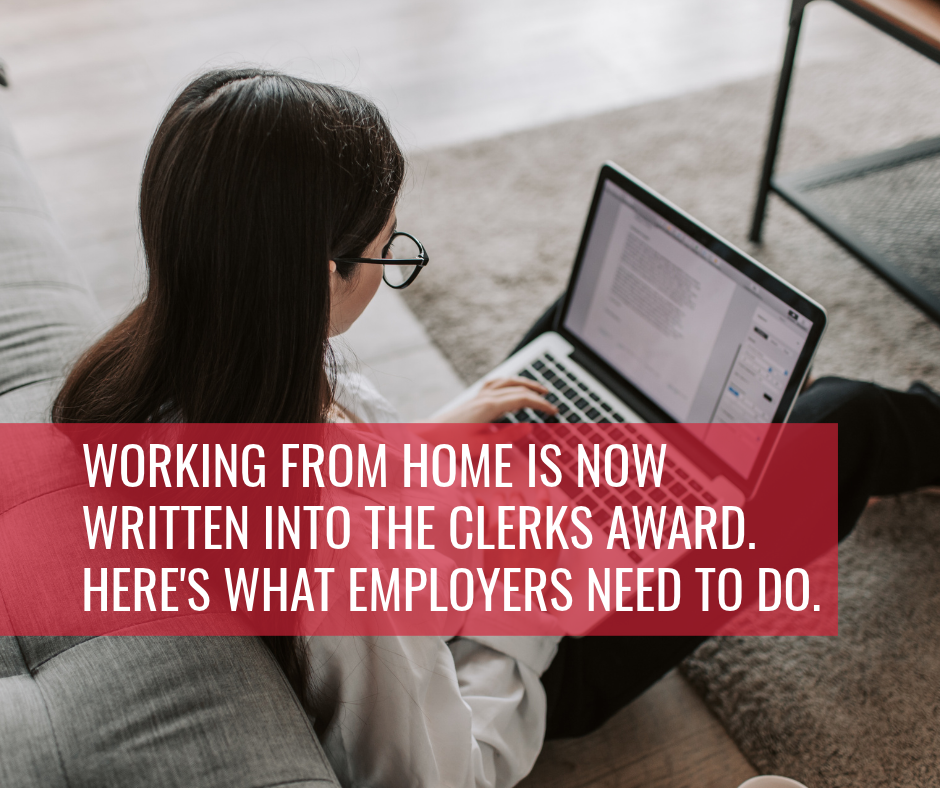
From 26 October 2026, the Clerks – Private Sector Award 2020 includes a new working from home clause. The Clerks Award covers around 1.56 million employees: receptionists, administration officers, payroll and accounts staff, office managers. If you employ office staff, this is about you.
Much of the commentary says employers “won” because there is no right to work from home. That’s the wrong read. Here’s what has changed and what to do about it.
What’s changed
After a two-year case, the Fair Work Commission has inserted a new clause 5A, “Requests for working from home arrangements”, into the Clerks Award. It took effect today.
The unions asked for a right to request working from home, with a presumption that requests would be approved. The Full Bench said no. There is no right to work from home.
What employees now have is a formal way to ask:
– An employee can request a working from home arrangement in writing.
– The employer can agree or decline.
– If agreed, the arrangement must be recorded in a written agreement, made without coercion or duress.
That sounds modest. The detail is where it gets interesting.
How it works
The request. It must be in writing and state the days of the week, or the number, proportion or pattern of days, the employee wants to work from home.
Your response. The clause sets no response time, no list of refusal grounds and no requirement to give reasons. But don’t mistake that for a free pass. Making a request is likely an exercise of a workplace right. Treat someone adversely because they asked, and you are in general protections territory, where the onus is on you to prove your reasons.
The agreement. If you say yes, the written agreement must set out:
– the days, or number, proportion or pattern of days, worked from home
– where the work will be performed
– any award terms you have agreed to modify
– the start date
– how the arrangement can be varied or ended
The flexibility it unlocks. This is the part most employers will want. By agreement, you can modify how the award applies to:
– the requirement to work ordinary hours continuously
– the employer’s control over when ordinary hours are worked
– the timing of rest and meal breaks
Existing facilitative provisions (spread of hours, make-up time, start and finish times, time off instead of overtime) can also be used. Overtime and penalty rates do not change.
Disputes. Disagreements about a request can be dealt with under the award’s dispute resolution clause, which can end up at the Fair Work Commission.
Why this matters more than the headlines suggest
Your current arrangements may already breach the award. The Commission found many existing working from home arrangements are likely non-compliant. Picture an admin officer who logs off at 3pm for school pick-up and finishes her day after dinner. Under the award, that isn’t continuous ordinary hours, and the evening work may attract overtime. Everyone is happy until the relationship sours, and then it becomes an underpayment claim.
Clause 5A is the fix. It can be used to formalise an existing arrangement, not just a new one.
The NES still applies alongside it. Eligible employees (generally 12 months’ service plus circumstances such as caring responsibilities, a school-age child, disability or being 55 or older) can still make a flexible working request under the Fair Work Act. Those requests need a written response within 21 days and can only be refused on reasonable business grounds. You may now receive requests under either pathway, and your process needs to handle both.
This won’t stop at clerks. The Commission flagged the clause as a possible model for other awards. Victoria is legislating a right to work from home up to two days a week, expected from 1 July 2027. The direction of travel is clear.
My top 5 tips for employers
- Find out who is working from home now, and on what terms. List every Clerks Award employee with a regular home-based arrangement. Note what was agreed, whether it’s written down, and how hours and breaks actually work.
- Put existing arrangements in writing under clause 5A. Use a short template covering days, location, any modified terms, start date and how it can be changed or ended. Keep signed copies with your time and wages records.
- Build a simple request process. One form, one decision-maker, a set response time. I’d suggest 21 days to mirror the NES. Assess each request on its merits and record your reasons, even though the clause doesn’t require them.
- Brief your managers. They need to know an employee asking to work from home is exercising a workplace right. No eye-rolling, no quiet sidelining, no “we’ll see how your performance goes first”. Consistency across teams is your best protection.
- Update your policy and your WHS approach. Your duty of care follows people home. Refresh your working from home policy, include a home workstation self-assessment, and consider psychosocial risks such as isolation and blurred work hours.
FAQ
Do employees now have a right to work from home? No. Clerks Award employees have a right to ask in writing. The employer can agree or decline.
Can I refuse a request? Yes. The clause sets no refusal grounds or response time. But you can’t treat someone adversely for asking, and an eligible employee may also request under the NES, where reasonable business grounds and a 21-day written response apply.
Does it apply to arrangements already in place? Yes. The clause can be used to formalise an existing arrangement. Given the Commission’s view that many current arrangements are likely non-compliant, that’s the smart move.
Does it change overtime or penalty rates? No. It changes how hours and breaks can be arranged by agreement. Overtime and penalty rates stay as they are.
Does it apply to Queensland councils? Generally, no. Queensland local government employees sit in the state industrial relations system, not the Clerks Award. It’s still a useful benchmark for council policy.
What about my NFP or other office staff? Check award coverage first. Some administrative roles in community services fall under the SCHADS Award or an enterprise agreement, not the Clerks Award.
The bottom line
Working from home isn’t going anywhere. Employers who get their arrangements documented now will use flexibility to attract and keep good people. Those who don’t may first hear about clause 5A in a dispute or an underpayment claim.
If you’d like a quick review of your working from home arrangements, policy or agreement template get in touch with the Harrisons team.

Claire Harrison is the Founder and Managing Director of Harrisons, a flourishing HR consulting business that sprouted in 2009 from Claire’s passionate belief that inspiring leaders and superstar employees are the key success factor to any business. With over 20 years’ experience, Claire has worked as a HR Director of multi-national organisations, as a Non-Executive Board Director, and a small business owner. Claire’s corporate career includes working with companies such as BHP, Westpac, Fonterra and Mayne Nickless.