I want to start with a number.
28.5%.
That is the proportion of Australians who have experienced child sexual abuse, according to the 2023 Australian Child Maltreatment Study. Of those, approximately 75% experienced it more than once.
These are not rare events. This is not a problem confined to certain families or certain communities. This is widespread, systemic, and — for far too long — met with institutional responses that compounded the harm rather than addressing it.
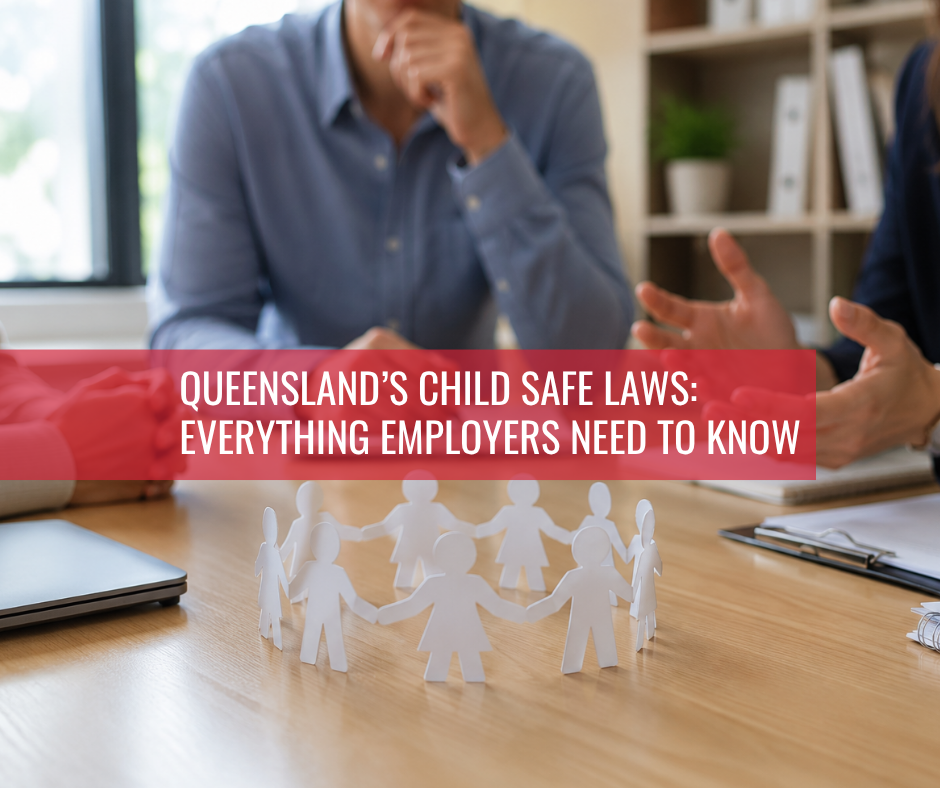
That is why, in 2024, Queensland enacted the Child Safe Organisations Act. And that is why, if your organisation provides services or spaces for children, this legislation changes what is expected of you.
This article covers everything employers, HR professionals and governance leads need to understand — what the law requires, who it applies to, and what you need to do. I have written it alongside a free 45-minute webinar on the same topic.
Why This Reform Exists: The Royal Commission
From 2013 to 2017, Australia conducted the Royal Commission into Institutional Responses to Child Sexual Abuse. It was a five-year national inquiry. More than 8,000 survivors shared their experiences. The final report spanned 57 volumes and contained 409 recommendations.
The findings were confronting. Child sexual abuse was found to be widespread across institutions — schools, churches, government services, sporting clubs, residential care, youth organisations. And critically, the way institutions had responded when abuse was reported was found to be profoundly inadequate. Children were not believed. Matters were covered up. Perpetrators were moved rather than investigated. The harm was compounded, repeatedly, by the response.
Queensland’s Child Safe Organisations Act 2024 is the legislative response to those recommendations. It is the most significant overhaul of child safeguarding obligations for employers and organisations in Queensland’s history — and it applies to approximately 40,000 Queensland organisations.
Understanding this context matters. The legislation is not bureaucratic compliance for its own sake. It exists because institutions have a documented history of failing children — and because the research tells us that failure remains common.
The Royal Commission did not find a problem at the edges of our institutions. It found that institutions had systematically failed the children in their care.
The Legal Framework: Two Obligations That Work Together
The Child Safe Organisations Act 2024 establishes two distinct obligations that operate alongside each other. Understanding the distinction is the key to understanding the legislation.
The 10 Child Safe Standards — Prevention
The first obligation is the 10 Child Safe Standards. These apply to every organisation that is a “child safe entity” — any organisation that provides services or spaces specifically for children. The Standards are about prevention: creating environments where children are safe from harm before anything goes wrong.
The Standards rolled out in three phases from October 2025 across all sectors. Every phase is now complete. Every child safe entity in Queensland is already required to comply.
The Reportable Conduct Scheme — Response
The second obligation is the Reportable Conduct Scheme, which commenced 1 July 2026. This applies to a narrower group of organisations — those defined as “reporting entities” under the Act. It is about response: what happens when harm or misconduct by a staff member or volunteer is alleged. It must be reported to the Queensland Family and Child Commission (QFCC) and properly investigated.
These two obligations have different scopes. Not every organisation that must comply with the 10 Child Safe Standards is also required to implement the Reportable Conduct Scheme. I will address this distinction in detail below. The oversight body for both is the Queensland Family and Child Commission (QFCC).
Who Needs the 10 Child Safe Standards?
The Act applies to any organisation that is a “child safe entity” — defined as one that provides services or spaces specifically for children, where some or all of its services, activities or programs are aimed at children, or have a special application for children.
Three points about this definition that organisations frequently get wrong:
- “Specifically” does not mean “exclusively.” If any part of your organisation serves children in any capacity, you are likely captured.
- The Act applies to the whole organisation. You cannot ringfence just the child-facing part of your operation. If your council runs a swim school, the child safe obligations apply across the entire council.
- A wide range of sectors are captured — not just childcare centres and schools.
The sectors in scope include: local government and councils; early childhood education and care; schools (state, independent and private); universities, TAFEs and RTOs; health service providers; disability services; sporting clubs and recreation organisations; gyms and fitness centres; community and not-for-profit organisations; religious and faith-based organisations; tutoring and education businesses; and play centres and commercial children’s venues.
The test: does your organisation deliver any services, activities or programs where children specifically participate? If yes — you are a child safe entity.
The 10 Child Safe Standards: What They Mean for Employers
The 10 Child Safe Standards are not aspirational values. They are legal obligations that require documented evidence, functioning systems and embedded practice. Having some policies is not the same as compliance. Understanding the distinction matters.
Here is what each Standard requires from an HR and people management perspective:
Standard 1 — Leadership, Governance and Culture
Child safety must be embedded in your organisation’s leadership and governance — not just acknowledged. A named accountable leader. Board-level risk reporting on child safety. A public commitment. And a culture where child safety is a genuine organisational value, not a compliance exercise. This is governance advisory work, and it sits with HR and the executive team.
Standard 2 — Children’s Voice and Participation
Children must be informed of their rights, meaningfully involved in decisions that affect them, and taken seriously when they raise concerns. For HR and complaints teams, this means designing complaint and disclosure processes that a child can actually use — not just adults.
Standard 3 — Families and Communities
Families and communities must be informed and engaged in your approach to child safety. This includes accessible grievance pathways and culturally appropriate communication.
Standard 4 — Equity and Diversity
The organisation must actively uphold children’s equity and respect diverse needs — including children with disability, children from culturally and linguistically diverse backgrounds, and Aboriginal and Torres Strait Islander children. The Universal Principle (covered below) runs through this Standard specifically.
Standard 5 — Suitability of People Working with Children
This is the Standard with the most direct and extensive HR workload. It covers the entire employment lifecycle for anyone working with children: employees, contractors and volunteers.
- Blue card verification must be built into every recruitment process — not as an afterthought but as an integral screening step
- Position descriptions must specifically state child safety responsibilities
- Structured induction must cover child safe obligations
- Ongoing supervision and monitoring of staff and volunteers
- Clear, documented processes for managing conduct concerns
- Reference checking that includes child safety awareness
Standard 6 — Child-Focused Complaints and Concerns
Your complaints process must be child-focused — designed so that a child can actually use it, not just adult staff or managers. It must be accessible, clearly communicated, have documented response timeframes, and be consistently applied. It must also link clearly to the Reportable Conduct Scheme where relevant.
Standard 7 — Staff and Volunteers Equipped Through Training
Completing a 30-minute online child protection module at induction three years ago does not meet this Standard. Training must be ongoing, role-appropriate (managers require different training to frontline workers), and evidenced. You must be able to demonstrate it through training registers and completion records. Training content must cover child safe behaviours, responding to disclosures, and each person’s legal obligations.
Standard 8 — Safe Physical and Online Environments
Your physical environments and digital spaces must be designed and managed to minimise opportunity for harm. Supervision ratios, physical space design, device and technology policies, and social media governance all fall within scope. The early childhood sector has specific additional requirements around personal device bans.
Standard 9 — Continuous Improvement
You must review and improve your child safety practices on a regular, documented basis. The QFCC can direct an organisation to complete a formal self-assessment at any time. This is not just good practice — it is the audit-readiness obligation.
Standard 10 — Documented Policies and Procedures
The Act requires a coherent, current, accessible policy suite — not a single document. At minimum: a Child Safety and Wellbeing Policy, Code of Conduct, Child-Focused Complaints Procedure, Child Safety Risk Management Plan, and Cultural Safety Strategy. All must be current, accessible to staff, and reflective of actual practice.
The Universal Principle: Cultural Safety Is Not Optional
Running through all 10 Standards is the Universal Principle: the active promotion and upholding of cultural safety for Aboriginal and Torres Strait Islander children.
This is not an 11th Standard. Every Standard must be applied through this lens.
Queensland’s unique geographic and demographic circumstances — particularly the needs of Aboriginal and Torres Strait Islander communities and rural and remote areas — were central to how the national framework was adapted for Queensland. The QFCC is explicit: to be genuinely culturally safe, the design of systems, structures, resources and implementation must be led by Aboriginal and Torres Strait Islander people. This is co-design, not consultation.
A lack of cultural safety is itself a form of harm under the Act. Adding a statement to a policy document does not create cultural safety.
The Universal Principle also encompasses actively employing Aboriginal and Torres Strait Islander peoples across organisations — not just in community-facing roles.
For organisations operating in or near First Nations communities, for councils with significant Indigenous populations, and for any organisation whose services reach Aboriginal and Torres Strait Islander children, this principle has specific and immediate implications for every aspect of your child safe framework — from how you recruit, to how you train, to how children and families can raise concerns.
The Reportable Conduct Scheme: A Different and Narrower Obligation
The Reportable Conduct Scheme is separate from the 10 Child Safe Standards and has a narrower scope. This distinction is critically important and frequently misunderstood.
Who Must Comply with Both the Standards AND the Scheme?
The Reportable Conduct Scheme applies to organisations defined as “reporting entities” — those where there is a structured, high degree of responsibility for children. These include: local government and councils; Queensland Government and public sector entities; child protection services; approved ECEC providers (but not nannies, babysitters or in-home childminders); schools, TAFEs, universities and RTOs; hospital and inpatient health services; disability services; religious bodies; justice and detention services; and certain accommodation services including homeless services, overnight camps and boarding school residences.
Who Needs the Standards Only — No Reportable Conduct Scheme Required?
Several significant sectors must comply with the 10 Child Safe Standards but are not required to implement the Reportable Conduct Scheme — at all, not eventually. These include: sporting clubs, P&C associations, swimming schools, performing arts groups, coaching and tutoring services, commercial children’s services (gyms, play centres, photography, entertainment, party services), community services and neighbourhood centres, transport services, and nannies, babysitters and in-home childminders.
If you are a sporting club, tutoring business or community neighbourhood centre, you have real compliance obligations under the 10 Standards. But you are not required to build a reportable conduct investigation and QFCC notification framework. Understanding which category you sit in changes your compliance picture significantly.
The Head of Entity: Personal Obligations Under the Scheme
For organisations captured by the Reportable Conduct Scheme, the obligations fall on the head of the entity — typically the CEO, Principal Officer or Managing Director. These are personal obligations, not corporate ones.
The head of entity must:
- Have systems in place that allow staff to report concerns about a colleague’s conduct with children
- Commence an internal investigation as soon as practicable
- Manage interim risk to children while the investigation is underway — documented decisions about stand-down, duty changes, or increased supervision
- Provide interim and final investigation reports to the QFCC
- Refer matters to police promptly where conduct may be criminal
$16,690
Penalty for failing to notify the QFCC of a reportable allegation — imposed on the head of entity personally. Details may be recorded on a public register. (100 penalty units under Queensland law)
The financial penalty is significant. But the reputational, regulatory and legal risk of mishandling a reportable conduct matter is far greater than any fine. The QFCC can review how investigations are conducted — and whether they met the required standard of procedural fairness.
What Is “Reportable Conduct”?
The Scheme captures six categories of conduct:
- Child sexual offences
- Sexual misconduct in relation to or in the presence of a child
- Ill-treatment of a child
- Significant neglect of a child
- Physical violence in relation to or in the presence of a child
- Behaviour causing significant emotional or psychological harm to a child
Off-duty conduct by a worker that raises concerns about their suitability to work with children can also be reportable — even if it did not occur in the workplace or during work hours.
This off-duty dimension significantly broadens what organisations need to be able to respond to. Your investigation processes must be capable of managing matters that may have occurred outside your premises, outside work hours, and in personal contexts.
The Investigation Obligation: The Hardest Part for Most Organisations
Your organisation must conduct an investigation. Not refer it to someone else. Not wait until you have more information. The obligation is to commence as soon as practicable.
There are five things that make investigations under this Scheme different from a routine HR matter:
- Procedural fairness is non-negotiable. Even in matters involving a serious allegation about a child — potentially a criminal matter — the person being investigated has procedural fairness rights. They must know what they are alleged to have done. They must have an opportunity to respond. Organisations that cut corners on procedural fairness create legal risk for themselves.
- Every step must be documented and defensible. The QFCC can review your investigation. They can assess whether it was conducted lawfully, fairly and with the child’s best interests at the centre. A poorly conducted investigation — even with the right outcome — can attract regulatory attention.
- Interim risk must be managed. What happens to the worker while you investigate? The decision about stand-down, duty changes or increased supervision must be documented with clear rationale.
- Police take priority where conduct may be criminal. You must refer to police promptly and not take steps that could compromise a police investigation. But you must still manage risk and report to the QFCC concurrently.
- You must report to the QFCC. Both an interim and a final report. The QFCC receives your findings and your process.
The question I hear from almost every organisation I work with is: “Who in our organisation conducts this investigation?” For the vast majority, the honest answer is: we do not currently have that person on staff. Workplace investigations — particularly those involving allegations touching on children — require experience, training, independence and familiarity with QFCC reporting requirements. This needs to be arranged before you need it, not during a live matter.
What We’re Seeing: Common Myths and Gaps
“Our CYRMS covers us.”
The Child and Youth Risk Management Strategy was the previous framework. It addressed some elements of what the new Standards require — but it is not equivalent to compliance with the Child Safe Organisations Act 2024, and it does not cover the Reportable Conduct Scheme at all. Almost every CYRMS we assess has material gaps against the current Act.
“We’re too small to be captured.”
The Act applies to volunteer clubs and small community organisations as much as it applies to large institutions. Size affects how you implement the obligations — it does not affect whether you must.
“This only applies to childcare centres and schools.”
Councils, gyms, tutoring businesses, sporting clubs, disability services, community organisations, arts bodies — all captured. Many organisations are discovering this too late.
“We have some policies — that should be enough.”
Having some policies is not a compliant policy suite. Policies must be current, accessible, coherent and reflective of actual practice. A child safety policy last reviewed in 2019 does not meet the Standard.
“The RCS will apply to us eventually.”
It may not. Sporting clubs, tutoring businesses, commercial children’s services, community neighbourhood centres and transport providers are not required to implement the Reportable Conduct Scheme — not now and not later. Understanding which category your organisation sits in changes your compliance priorities significantly.
How Harrisons Can Help
At Harrisons, we are HR and people management experts, not child safety specialists. But as this article demonstrates, the obligations under the Child Safe Organisations Act 2024 are fundamentally HR and people management work — governance, recruitment, training, investigations, policies and culture. It is where our expertise sits, and it is where 15 years of working with Queensland councils, community organisations, childcare services and not-for-profits has prepared us.
Governance & Board Education
Board briefings, governance strategy, Standard 1 implementation, executive accountability frameworks and public commitment development.
Audit & Compliance Assessment
Gap analysis against all 10 Child Safe Standards AND Reportable Conduct Scheme readiness — delivered as a branded findings report with prioritised action plan.
Workplace Investigation Services
Outsourced investigations by Harrisons-qualified practitioners; coaching and training to build your internal investigation capability; a Harrisons-managed confidential complaints line.
Bridging the Gaps — Child Safe Projects
Culture change, leadership development, Board education programs, EES surveys, strategy facilitation, recruitment and induction design, training programs and policy development.
Child Safe Policy Suite
Child Safety Policy, Code of Conduct, Complaints Procedure, Risk Management Plan and Cultural Safety Strategy — tailored to your sector, not generic templates.
Recruitment & Screening Design
Blue card workflows, child-safe position descriptions, pre-employment checks, suitability assessment and structured induction frameworks.
Child Safe Training & Education
Role-appropriate training for staff, volunteers and managers — child safe behaviours, responding to disclosures, and manager obligations.
Ongoing Compliance Retainer
Annual review cycles, policy refresh, register upkeep and audit-readiness support — continuous compliance, not a one-off project.
Ready to Find Out Where Your Organisation Stands?
Child safety compliance is not a project with a finish line. It is an ongoing organisational commitment that requires the right systems, the right people and the right culture.
Most organisations we speak with are not yet fully compliant. That is not a criticism — it is an observation. The good news is that with the right support, it is entirely achievable. The first step is understanding where you actually are.
Free 30-Minute Consultation
Tell us about your organisation and your most pressing concerns. We’ll give you honest, practical guidance on where to start — no obligation, no sales pitch.
CONTACT US: https://hhr.com.au/contact/
With the topic CHILDSAFE and we’ll be in touch within 24 hours to arrange a time.
Further Resources
- QFCC Child Safe Hub: qfcc.qld.gov.au/childsafe
- QFCC Official Webinar (50 min, on-demand): youtu.be/lxmO-Q0TWos
- Australian Child Maltreatment Study 2023: acms.net.au
Harrisons (Harrison Human Resources Pty Ltd) is a Brisbane-based HR consulting firm. Claire Harrison FCPHR is the Managing Director. For further information on Queensland’s child safe obligations, visit qfcc.qld.gov.au/childsafe. This article is for general information only and does not constitute legal advice.

Claire Harrison is the Founder and Managing Director of Harrisons, a flourishing HR consulting business that sprouted in 2009 from Claire’s passionate belief that inspiring leaders and superstar employees are the key success factor to any business. With over 20 years’ experience, Claire has worked as a HR Director of multi-national organisations, as a Non-Executive Board Director, and a small business owner. Claire’s corporate career includes working with companies such as BHP, Westpac, Fonterra and Mayne Nickless.