employee relations

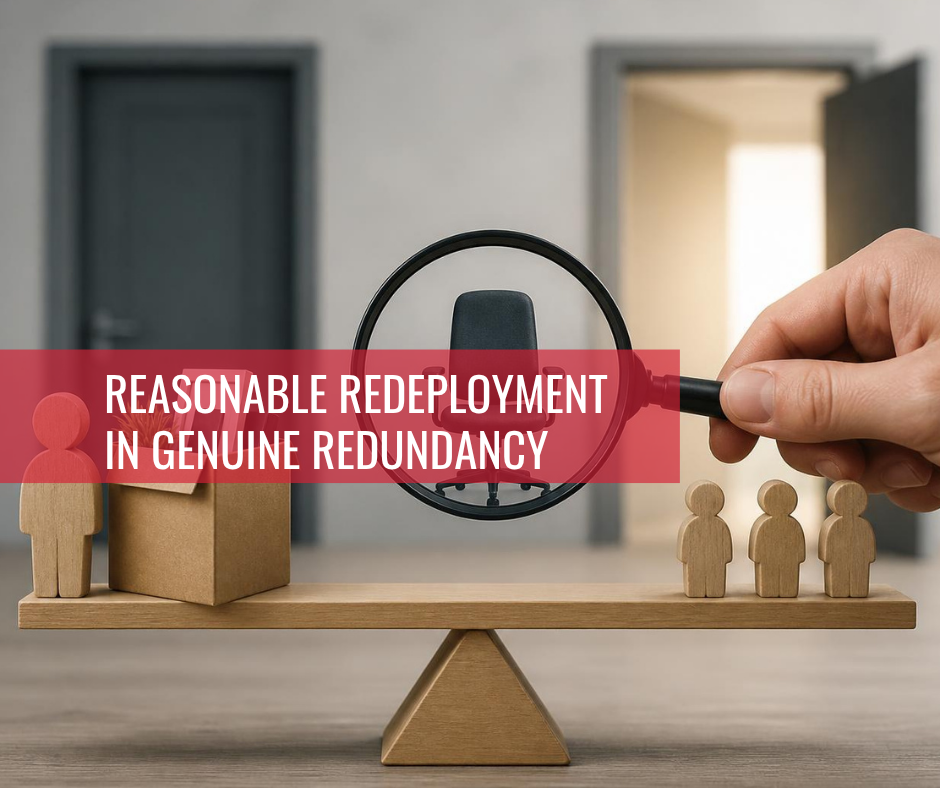
Featured image showing a balance scale with employee figures, a vacant office chair under a magnifying glass, and redundancy symbols, representing reasonable redeployment assessments during a genuine redundancy process.

Reasonable Redeployment in Genuine Redundancy: Why “No Vacancies” Is No Longer Enough After the High Court’s Helensburgh Decision

When you make a role redundant, can you rely on the fact that there were simply no other jobs going? Not any more.  Following the High Court’s 2025 decision in the Helensburgh Coal matter, “reasonable redeployment” under section 389 of the Fair Work Act now reaches beyond a list of vacant positions — in some cases it extends
Reasonable Redeployment in Genuine Redundancy: Why “No Vacancies” Is No Longer Enough After the High Court’s Helensburgh Decision Read More »

Featured image showing an open office doorway leading to a workplace, symbolising an employee's return to work, injury recovery, workplace reintegration, and employer responsibilities under Australian employment and WHS laws.

Return to Work Under Pressure: Managing Injury, Capacity and Employer Risk in the Australian Workplace

Managing ill and injured employees is one of the highest-risk tasks any Australian employer faces. When a worker is injured or falls ill, several legal regimes switch on at once — and they don’t always agree. Get it right and you protect your people and your organisation. Get it wrong and one termination can trigger multiple claims.  Here’s how to do it —

Return to Work Under Pressure: Managing Injury, Capacity and Employer Risk in the Australian Workplace Read More »

Featured image showing workplace investigation documents, a clipboard checklist, office files, and a pen, representing procedural fairness, workplace investigations, and compliant HR processes.

Workplace Investigations Done Right: How to Protect Your Organisation Through Process, Procedural Fairness and Privilege

A well-run workplace investigation is one of the strongest risk-management tools an Australian employer has. Done properly, it gives you a defensible basis to act on misconduct. Done poorly, the investigation itself becomes the liability — often costing more than the original complaint.  The difference comes down to process: right scope, procedural fairness, privilege considered early, and

Workplace Investigations Done Right: How to Protect Your Organisation Through Process, Procedural Fairness and Privilege Read More »

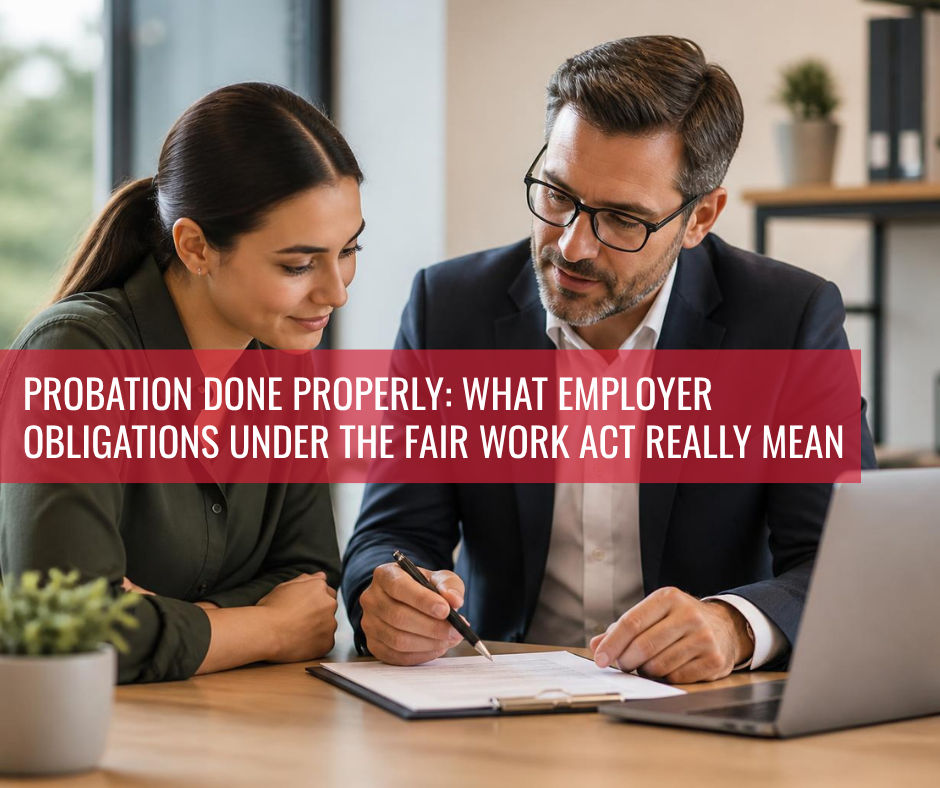
Featured image showing a manager reviewing probation documents with a new employee, representing probation management, performance discussions, and employer obligations under the Fair Work Act.

Probation Done Properly: What Employer Obligations Under the Fair Work Act Really Mean

Probation is not a legal safe zone. Ending employment during probation removes unfair dismissal exposure — but not a general protections claim, a discrimination complaint, or a breach of contract. Getting the fundamentals right keeps you out of trouble.  What’s the real issue?  Employers routinely confuse two very different things:  A contractual probation period — a creature of contract

Probation Done Properly: What Employer Obligations Under the Fair Work Act Really Mean Read More »

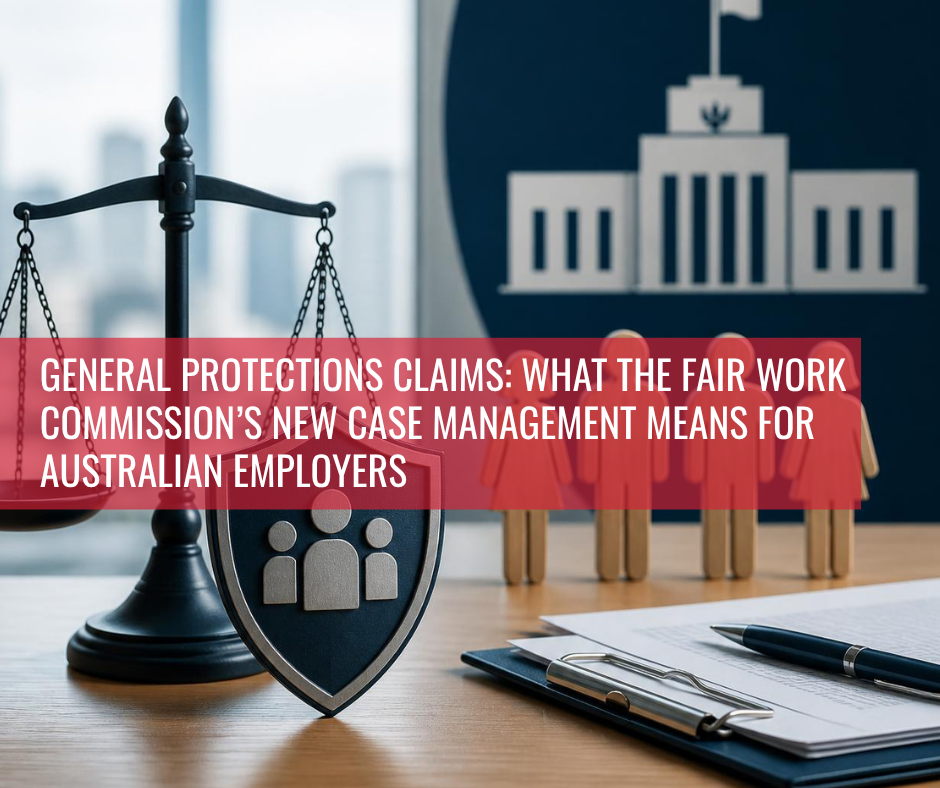
Featured image showing legal scales, a shield with people icons, workplace documents, and silhouettes of employees, representing general protections claims and Fair Work Commission case management for Australian employers.

General Protections Claims: What the Fair Work Commission’s New Case Management Means for Australian Employers

The Fair Work Commission has overhauled how general protections claims are run, and the shift favours prepared employers. Representation is decided “on the papers” before conference; out-of-time applications are triaged before you are served; conciliation is a fast 60-minute, resolution-only session; and a new Early Dispute Resolution (EDR) pilot tests informal settlement calls soon after lodgement. The reforms reward preparation

General Protections Claims: What the Fair Work Commission’s New Case Management Means for Australian Employers Read More »

Harrisons Webinar on HR and employment law for 2026

HR & Workplace Relations Trends for 2026: What Employers Need To Know

As we step into 2026, Australian workplaces are facing one of the fastest periods of transformation in recent memory. From technological disruption to shifting workforce expectations and major legislative reform, employers must be more proactive than ever to stay compliant, competitive and people-centred. In today’s Harrison’s Webinar, Managing Director Claire Harrison unpacked the 12 most

HR & Workplace Relations Trends for 2026: What Employers Need To Know Read More »

2025 Employment Law Updates: Insights from Christy Miller, Partner at Clayton Utz

At our 2025 End-of-Year event, we were privileged to host Christy Miller, Partner at Clayton Utz, who delivered a timely and engaging presentation titled “The Ghosts of Christmas Past, Present and Future (Also known as the 2025 Employment Law Updates).” The session provided essential updates and practical guidance for business leaders navigating the evolving landscape

2025 Employment Law Updates: Insights from Christy Miller, Partner at Clayton Utz Read More »

Reward & Recognition for Under $50: Meaningful Engagement That Doesn’t Break the Bank

In today’s competitive workplace, retaining great people and building a thriving culture isn’t just about salary—it’s about making employees feel valued, seen, and appreciated. Recognition is one of the most powerful drivers of engagement, loyalty, and performance, and it doesn’t have to cost a fortune. In fact, the most meaningful gestures are often simple, authentic,

Reward & Recognition for Under $50: Meaningful Engagement That Doesn’t Break the Bank Read More »

Human Resources Consultants

Changes for Australian Employers from 1 July 2024: Key Updates and Practical Tips

From 1 July 2024, several significant changes impacting employers in Australia will come into effect. These changes, stemming from the Fair Work Commission’s annual wage review and various legislative updates, will influence wages, superannuation, independent contractor rights, unfair dismissal compensation, delegates’ rights, and the handling of casual employment. Understanding and preparing for these changes is

Changes for Australian Employers from 1 July 2024: Key Updates and Practical Tips Read More »

federal budget for employers and HR

Advice for Australian Employers on the New Federal Budget

The recent release of the Australian Federal Budget brings several key changes and initiatives that will impact businesses and employers across the country. Harrisons, as your HR business partner, are here to help you navigate these changes and optimise your operations in light of the new budget. Key Impacts on Employers: Job Creation and Skills

Advice for Australian Employers on the New Federal Budget Read More »

Fair Work Act Closing Loopholes

Closing Loopholes: Additional Fair Work Act Changes

In a significant step towards reinforcing workplace fairness, the Australian Government announced the ‘Closing Loopholes’ initiative, building on the initial legislative amendments introduced in December 2023. This recent development aims to address gaps within the current framework, ensuring a more equitable work environment for all. As these changes unfold, it’s imperative for employers and employees

Closing Loopholes: Additional Fair Work Act Changes Read More »

2023 Trends in Human Resources 2024

MAXIMISING 2023 HR TRENDS: STRATEGIES FOR BUSINESSES IN 2024

The landscape of Human Resources is constantly evolving, and 2023 has been a pivotal year in shaping future trends. As we look towards 2024, it’s essential for HR managers, leaders, executives, company directors, and SME business owners to not only understand these trends but also strategise effectively to leverage them. This article explores the top

MAXIMISING 2023 HR TRENDS: STRATEGIES FOR BUSINESSES IN 2024 Read More »

Churches of Christ

Navigating Restructuring & Downsizing: A Human-Centric Approach in Tough Economic Times

In hard economic times, businesses often face the challenging decision of restructuring and downsizing. While this decision is primarily driven by financial imperatives, the method by which it is executed can have profound implications on a company’s people, culture, and overall workplace environment. The process of restructuring and redundancy should not only focus on balance

Navigating Restructuring & Downsizing: A Human-Centric Approach in Tough Economic Times Read More »

Scroll to Top