
fair work act

Featured image for “Performance Management That Holds Up” showing an office desk with a laptop, performance charts, workflow documents and reports.

Performance Management That Holds Up: Why a Valid Reason Is Only Half the Defence

An engineer with thirty years’ experience was dismissed for genuinely substandard work. Missed deadlines. Quality problems. A welding error that halted a production line.  The Fair Work Commission accepted there was a valid reason to dismiss him. He won anyway — and was awarded compensation of $21,471.15 plus superannuation — because the employer had no formal performance management process and gave him

Performance Management That Holds Up: Why a Valid Reason Is Only Half the Defence Read More »
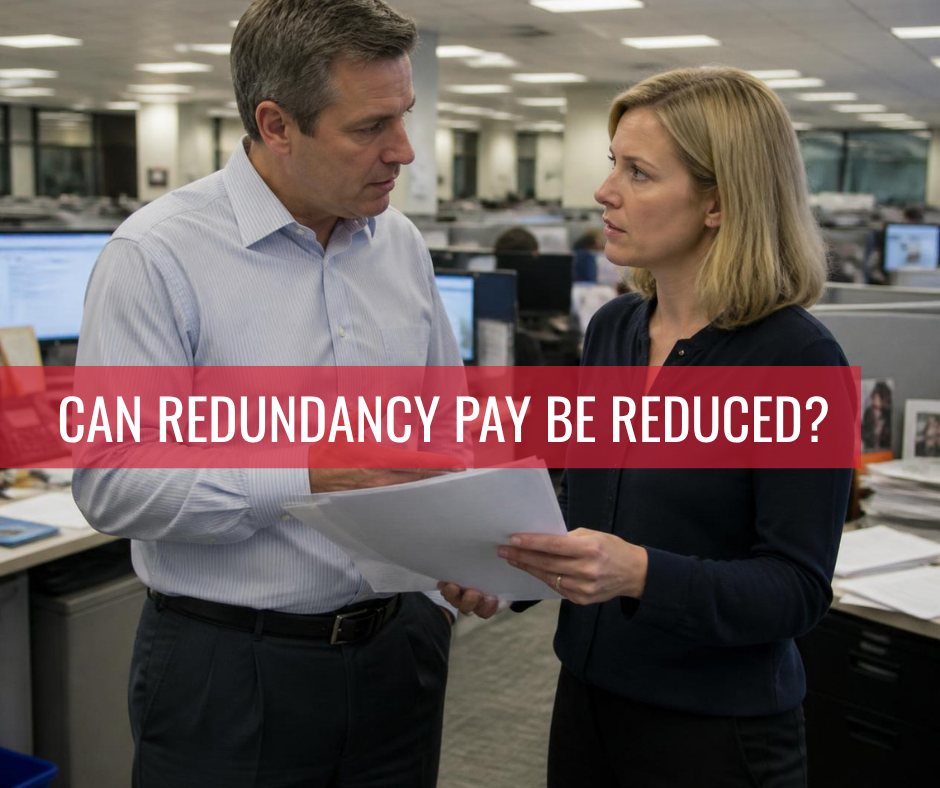
Two colleagues discussing redundancy documents in an office, representing redundancy pay and alternative employment considerations.

Can Redundancy Pay Be Reduced? What “Other Acceptable Employment” Really Means Under Section 120

Most employers know that a genuine redundancy triggers redundancy pay. Far fewer know that the Fair Work Commission can reduce that payment — sometimes to nothing — where the employer has obtained other acceptable employment for the employee.  And far fewer still appreciate the sting in the test: whether the alternative employment is “acceptable” is judged objectively. It does

Can Redundancy Pay Be Reduced? What “Other Acceptable Employment” Really Means Under Section 120 Read More »

Featured image showing stacks of employment documents and contracts on a desk, representing the complexities of determining whether a worker is a contractor or employee under Australian workplace laws.

Contractor or Employee? Why One Worker Can Be Both — and What Misclassification Now Costs

“They invoice us. They have an ABN. They’re a contractor.”  That reasoning has never been enough, and in 2026 it is actively dangerous. A single worker can be a contractor at common law, an employee for superannuation purposes, and a deemed employee for payroll tax — all at the same time, under three different tests. 

Contractor or Employee? Why One Worker Can Be Both — and What Misclassification Now Costs Read More »

Non-compete agreement marked out beside a 2027 calendar block, representing proposed changes to non-compete clauses in Australian employment contracts.

The End of the Standard Non-Compete: How to Protect Your Business Before the 2027 Restraint Reforms

There is a clause in almost every Australian employment contract that most employers have never tested, many could not enforce, and a great number are about to lose.  The Government has announced that from 2027 it will ban non-compete clauses for workers earning below the Fair Work Act high-income threshold, and prohibit wage-fixing and no-poach agreements between businesses. The reforms are not law yet. But the work

The End of the Standard Non-Compete: How to Protect Your Business Before the 2027 Restraint Reforms Read More »

Featured image for The Employer’s Compliance Calendar 2026–27 showing a digital compliance timeline alongside workplace policy and legal folders.

Six Changes, Eighteen Months: The Australian Employer’s Compliance Calendar for 2026 and 2027

Most employers do not get caught out by the law they never heard of. They get caught out by the change they heard about, filed away, and did not diarise.  Between 1 July 2026 and the end of 2027 there are six separate changes with hard start dates, each requiring a different function to act — payroll, HR,

Six Changes, Eighteen Months: The Australian Employer’s Compliance Calendar for 2026 and 2027 Read More »

Manager discussing a flexible work request with an employee across a desk, with legal symbols including scales of justice, a gavel, and hybrid work icons representing Australian workplace flexibility and Fair Work compliance.

Flexible Work Requests: What Recent Fair Work Commission Decisions Require of Employers

What’s the real issue?  Since the 2023 changes to the Fair Work Act 2009 (Cth), how you handle a flexible work request now matters as much as whether you say yes or no. Under section 65B, the Fair Work Commission (FWC) can now arbitrate refused requests — and order you to grant one anyway if you did not follow the

Flexible Work Requests: What Recent Fair Work Commission Decisions Require of Employers Read More »

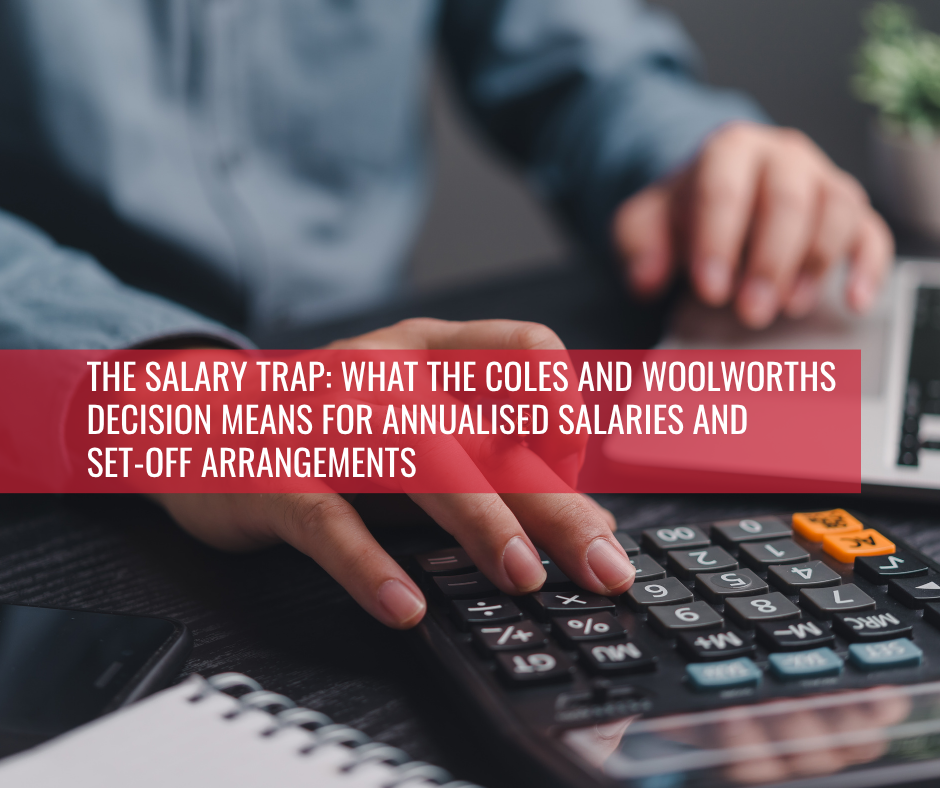
Featured image showing a calculator, financial documents, and payroll calculations, representing annualised salaries, set-off arrangements, payroll compliance, and employee wage entitlements under Australian employment law.

The Salary Trap: What the Coles and Woolworths Decision Means for Annualised Salaries and Set-Off Arrangements

If you pay an annual salary to award-covered staff, the Coles and Woolworths underpayment decision should be on your radar. Paying a generous salary that “washes out” over a year is no longer enough: a set-off must satisfy award entitlements in each pay period — not on average across the year. That point redraws the compliance map for Australian

The Salary Trap: What the Coles and Woolworths Decision Means for Annualised Salaries and Set-Off Arrangements Read More »

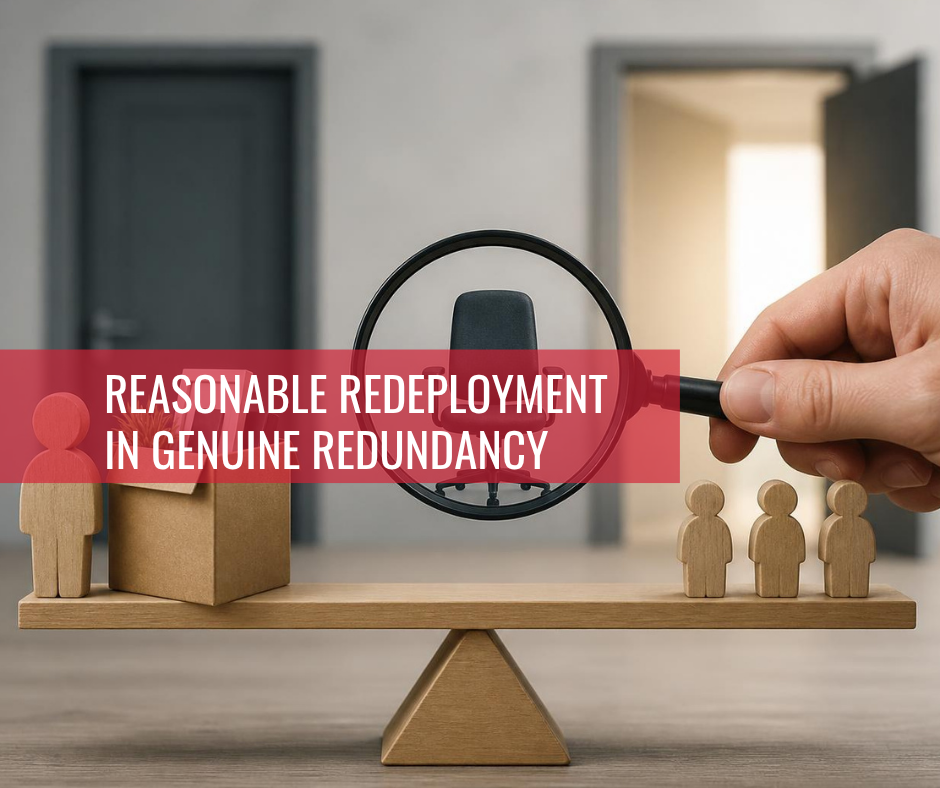
Featured image showing a balance scale with employee figures, a vacant office chair under a magnifying glass, and redundancy symbols, representing reasonable redeployment assessments during a genuine redundancy process.

Reasonable Redeployment in Genuine Redundancy: Why “No Vacancies” Is No Longer Enough After the High Court’s Helensburgh Decision

When you make a role redundant, can you rely on the fact that there were simply no other jobs going? Not any more.  Following the High Court’s 2025 decision in the Helensburgh Coal matter, “reasonable redeployment” under section 389 of the Fair Work Act now reaches beyond a list of vacant positions — in some cases it extends

Reasonable Redeployment in Genuine Redundancy: Why “No Vacancies” Is No Longer Enough After the High Court’s Helensburgh Decision Read More »

Featured image showing an open office doorway leading to a workplace, symbolising an employee's return to work, injury recovery, workplace reintegration, and employer responsibilities under Australian employment and WHS laws.

Return to Work Under Pressure: Managing Injury, Capacity and Employer Risk in the Australian Workplace

Managing ill and injured employees is one of the highest-risk tasks any Australian employer faces. When a worker is injured or falls ill, several legal regimes switch on at once — and they don’t always agree. Get it right and you protect your people and your organisation. Get it wrong and one termination can trigger multiple claims.  Here’s how to do it —

Return to Work Under Pressure: Managing Injury, Capacity and Employer Risk in the Australian Workplace Read More »

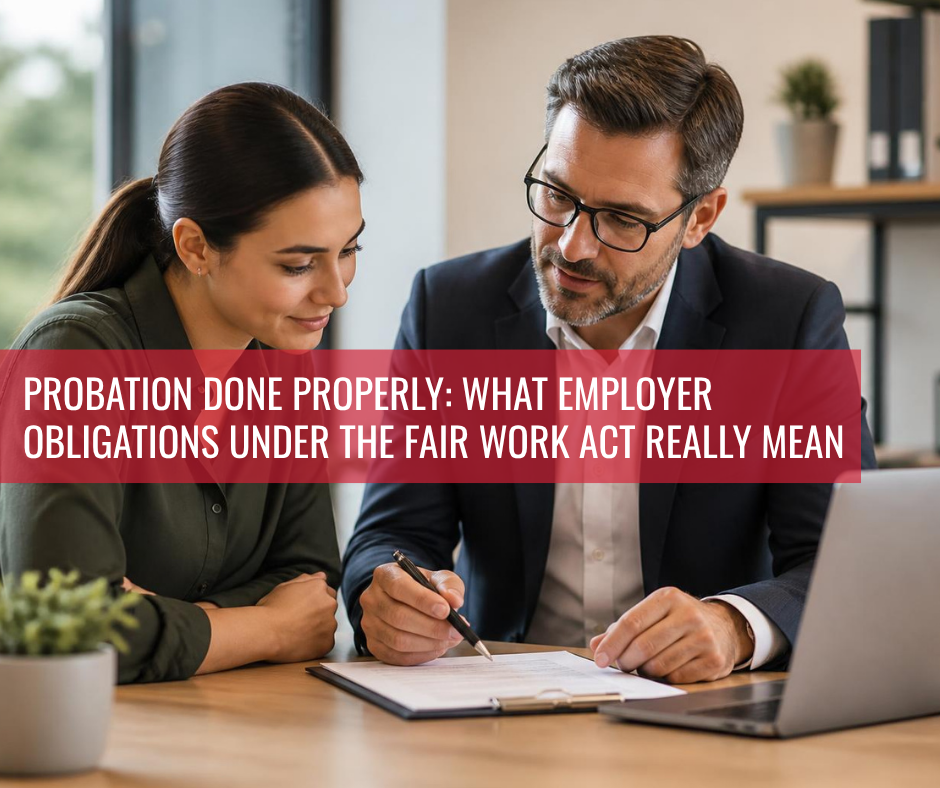
Featured image showing a manager reviewing probation documents with a new employee, representing probation management, performance discussions, and employer obligations under the Fair Work Act.

Probation Done Properly: What Employer Obligations Under the Fair Work Act Really Mean

Probation is not a legal safe zone. Ending employment during probation removes unfair dismissal exposure — but not a general protections claim, a discrimination complaint, or a breach of contract. Getting the fundamentals right keeps you out of trouble.  What’s the real issue?  Employers routinely confuse two very different things:  A contractual probation period — a creature of contract

Probation Done Properly: What Employer Obligations Under the Fair Work Act Really Mean Read More »

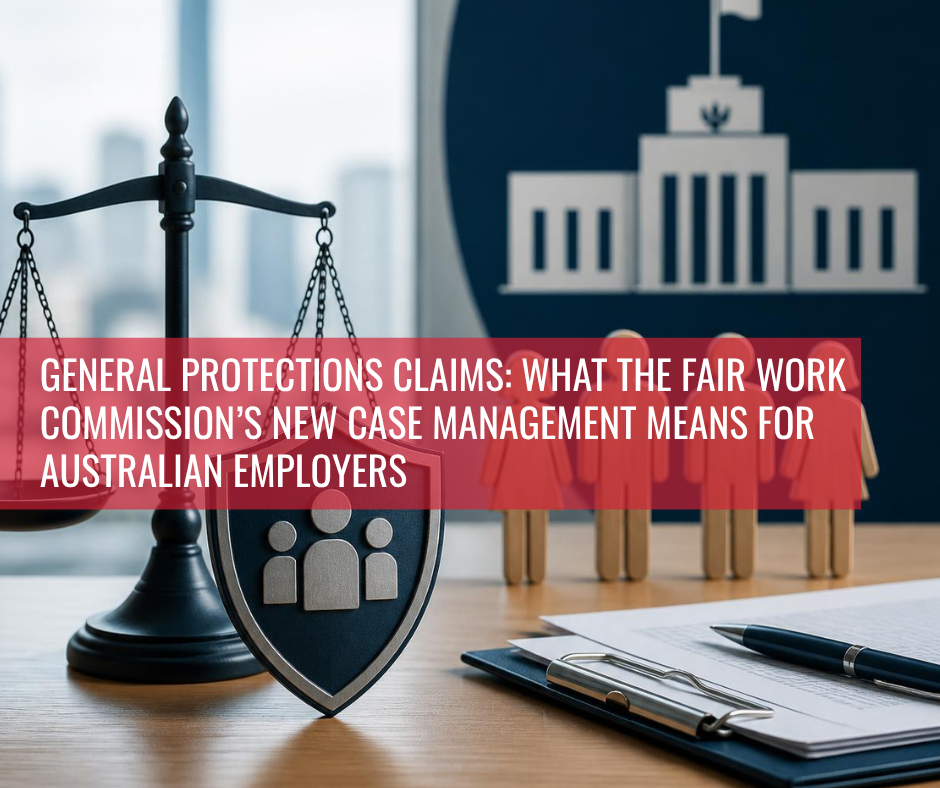
Featured image showing legal scales, a shield with people icons, workplace documents, and silhouettes of employees, representing general protections claims and Fair Work Commission case management for Australian employers.

General Protections Claims: What the Fair Work Commission’s New Case Management Means for Australian Employers

The Fair Work Commission has overhauled how general protections claims are run, and the shift favours prepared employers. Representation is decided “on the papers” before conference; out-of-time applications are triaged before you are served; conciliation is a fast 60-minute, resolution-only session; and a new Early Dispute Resolution (EDR) pilot tests informal settlement calls soon after lodgement. The reforms reward preparation

General Protections Claims: What the Fair Work Commission’s New Case Management Means for Australian Employers Read More »

Two professionals shaking hands in a modern office while discussing employment terms and pay arrangements.

Loaded pay rates: a tempting handshake that can land you in serious trouble

At a franchisor presentation last night, a franchisee asked me a question that I suspect plays out in workplaces across Australia every single day.  A promising candidate negotiates a higher hourly rate. The employer agrees — and to keep things simple, says the rate also covers the tool allowance and annual leave loading. Everyone shakes

Loaded pay rates: a tempting handshake that can land you in serious trouble Read More »

A landmark Federal Court decision reshapes BOOT compliance, annualised salaries and offset clauses. Here’s what Australian employers must review now.

The New “Pay-Period” BOOT: What the Landmark Ruling Means for Employers

A recent Federal Court decision has fundamentally changed how Australian employers must think about annualised salaries, offset clauses and the Better Off Overall Test (BOOT). Often referred to as the “pay period boundary” ruling, this decision has wide ranging implications for payroll, HR, employment contracts and record keeping practices across all industries — not just

The New “Pay-Period” BOOT: What the Landmark Ruling Means for Employers Read More »

Mental Health First Aid at Work: Learn how employers can manage psychosocial hazards, meet WHS obligations, and build a compliant workplace mental health strategy.

Mental Health First Aid at Work: A Practical Guide for Employers

Mental health in the workplace is no longer a “nice to have” conversation — it is a business-critical priority.  In a recent HR Bites webinar, I explored the role of Mental Health First Aid at Work within a broader workplace mental health strategy, and the practical steps employers can take to manage psychological risk, meet

Mental Health First Aid at Work: A Practical Guide for Employers Read More »

Pregnancy, Restructures and Flexible Work Managing Risk Under the Fair Work Act

Pregnancy, Restructures and Flexible Work – Managing Risk Under the Fair Work Act

Workplaces are increasingly navigating complex situations where business change intersects with employee rights. One of the most sensitive scenarios occurs when an employee who is pregnant is affected by organisational change and requests adjustments to their work arrangements.  Handled well, these situations strengthen trust and demonstrate leadership maturity. Handled poorly, they can expose organisations to claims under the Fair Work Act 2009

Pregnancy, Restructures and Flexible Work – Managing Risk Under the Fair Work Act Read More »

Sexual Harassment

New Sexual Harassment Regulations: What Businesses Need to Know

From 1 September 2024, new regulations have come into effect aimed at preventing sexual harassment and gender-based harassment in the workplace. Here’s what you need to know to stay compliant and protect your employees. 1. Proactive Steps to Eliminate Harassment (Effective Now) Starting from 1 September 2024, businesses (referred to as PCBUs, which means “Persons

New Sexual Harassment Regulations: What Businesses Need to Know Read More »

Understanding the Latest Updates to The Fair Work Act

Understanding the Latest Updates to The Fair Work Act

In August 2024, Claire Harrison, Managing Director of Harrisons, presented an insightful webinar on the latest updates to the Fair Work Act. This comprehensive presentation covered several key changes that businesses need to be aware of to ensure compliance and maintain a positive workplace environment.  The New Right to Disconnect  One of the significant updates

Understanding the Latest Updates to The Fair Work Act Read More »

Harrisons HR Conference - Fair Work Changes, AI in HR, Leadership

Harrisons HR Mini-Conference 2024 Recap – Fair Work Act Changes, Psychosocial Hazards, and AI in HR

Harrisons Mini-HR Conference, an exclusive event designed for HR consultants and business leaders was held on Friday, 26 July 2024 in Brisbane. Don’t miss our upcoming webinar covering the Fair Work Act changes over July/August 2024. Our Keynote Speakers: * John Sneddon, Shand Taylor Lawyers * Christy Miller, Clayton Utz * Adele Garnett, HopgoodGanim Lawyers *

Harrisons HR Mini-Conference 2024 Recap – Fair Work Act Changes, Psychosocial Hazards, and AI in HR Read More »

FWA Changes

August 2024 – Fair Work Act Changes: What Employers Need to Know

Significant changes to the Fair Work Act will impact Australian workplaces this month. These updates bring new obligations and rights for both employers and employees. It’s essential to understand these changes to ensure compliance and maintain a positive working environment. At Harrisons, we’re here to provide clarity and support as you navigate these updates.  1

August 2024 – Fair Work Act Changes: What Employers Need to Know Read More »

Human Resources Consultants

Changes for Australian Employers from 1 July 2024: Key Updates and Practical Tips

From 1 July 2024, several significant changes impacting employers in Australia will come into effect. These changes, stemming from the Fair Work Commission’s annual wage review and various legislative updates, will influence wages, superannuation, independent contractor rights, unfair dismissal compensation, delegates’ rights, and the handling of casual employment. Understanding and preparing for these changes is

Changes for Australian Employers from 1 July 2024: Key Updates and Practical Tips Read More »

federal budget for employers and HR

Advice for Australian Employers on the New Federal Budget

The recent release of the Australian Federal Budget brings several key changes and initiatives that will impact businesses and employers across the country. Harrisons, as your HR business partner, are here to help you navigate these changes and optimise your operations in light of the new budget. Key Impacts on Employers: Job Creation and Skills

Advice for Australian Employers on the New Federal Budget Read More »

Managing Psychosocial Hazards at Work

Code of Practice: Managing Psychosocial Hazards at Work

The genesis of the new regulation can be traced back to the 2018 Boland Review of the Model OHS Laws, which identified a significant gap in how psychological health was addressed in the existing laws. The review highlighted stakeholders’ concerns that psychological health is often neglected and recommended further regulation to provide clear, practical guidance.

Code of Practice: Managing Psychosocial Hazards at Work Read More »

Fair Work Act Closing Loopholes

Closing Loopholes: Additional Fair Work Act Changes

In a significant step towards reinforcing workplace fairness, the Australian Government announced the ‘Closing Loopholes’ initiative, building on the initial legislative amendments introduced in December 2023. This recent development aims to address gaps within the current framework, ensuring a more equitable work environment for all. As these changes unfold, it’s imperative for employers and employees

Closing Loopholes: Additional Fair Work Act Changes Read More »

Employment Law Compliance

NAVIGATING REGULATORY COMPLIANCE AND CHANGING EMPLOYMENT LAWS: A GLOBAL BUSINESS IMPERATIVE

In today’s rapidly evolving legal landscape, staying abreast of regulatory compliance and changing employment laws is paramount for businesses, people leaders, company directors, and entrepreneurs globally. As workplaces become more diverse and the nature of work more complex, understanding and adhering to these changing regulations is not just about legal necessity but also about fostering

NAVIGATING REGULATORY COMPLIANCE AND CHANGING EMPLOYMENT LAWS: A GLOBAL BUSINESS IMPERATIVE Read More »

client logo - Human Resources Brisbane | Best Workplace Assessment

Employers Beware – End of Year is Nearly Here! The Silly Season!

  Are you ready for the festive session/Christmas-New Year period/end of year office closure/the silly season? Whatever you call it, it’s just around the corner so you need to be business-ready. Here are our 3 tips to get you started on your people planning for end of year. 1.  Message from the CEO End of

Employers Beware – End of Year is Nearly Here! The Silly Season! Read More »

Scroll to Top