Award Compliance

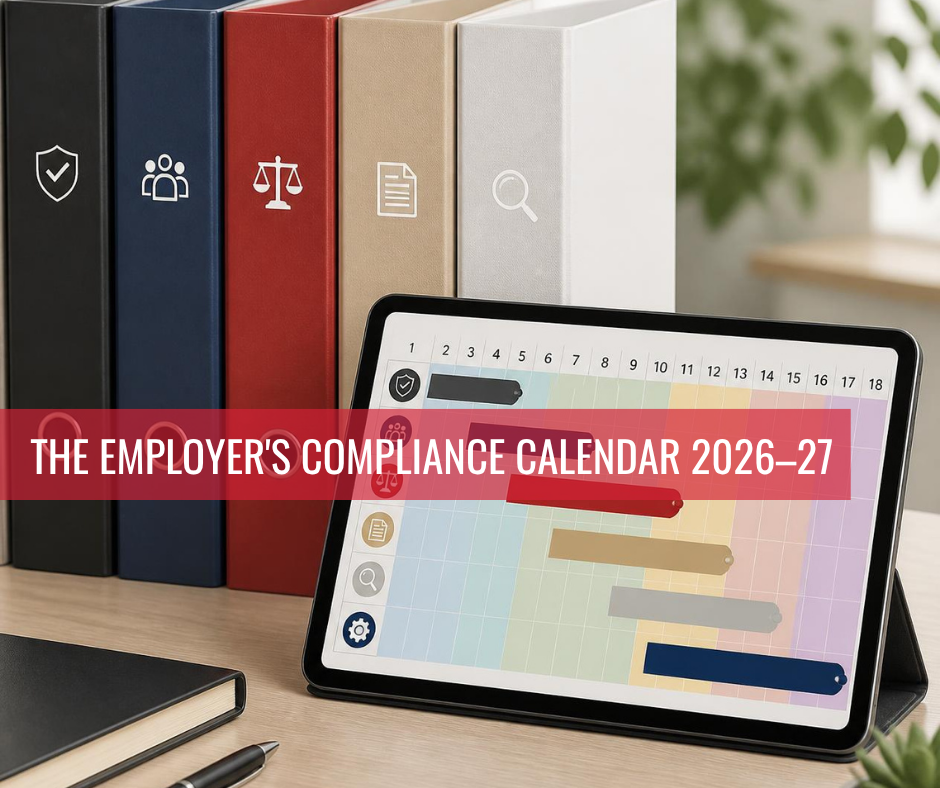
Featured image for The Employer’s Compliance Calendar 2026–27 showing a digital compliance timeline alongside workplace policy and legal folders.

Six Changes, Eighteen Months: The Australian Employer’s Compliance Calendar for 2026 and 2027

Most employers do not get caught out by the law they never heard of. They get caught out by the change they heard about, filed away, and did not diarise.  Between 1 July 2026 and the end of 2027 there are six separate changes with hard start dates, each requiring a different function to act — payroll, HR,

Six Changes, Eighteen Months: The Australian Employer’s Compliance Calendar for 2026 and 2027 Read More »

Featured image showing a calculator, financial documents, and payroll calculations, representing annualised salaries, set-off arrangements, payroll compliance, and employee wage entitlements under Australian employment law.

The Salary Trap: What the Coles and Woolworths Decision Means for Annualised Salaries and Set-Off Arrangements

If you pay an annual salary to award-covered staff, the Coles and Woolworths underpayment decision should be on your radar. Paying a generous salary that “washes out” over a year is no longer enough: a set-off must satisfy award entitlements in each pay period — not on average across the year. That point redraws the compliance map for Australian

The Salary Trap: What the Coles and Woolworths Decision Means for Annualised Salaries and Set-Off Arrangements Read More »

Two business professionals reviewing workplace compliance documents in a modern office ahead of major Australian employment law changes taking effect on 1 July 2026.

What’s changing on 1 July 2026 — and what to do about it before it lands

Every July brings a wave of workplace law changes. Most years you can absorb them with a payroll update and a quick policy review. 2026 is not that year.  The changes landing on 1 July 2026 are structural — not cosmetic. They alter how super is paid, how parental leave is funded, what counts as

What’s changing on 1 July 2026 — and what to do about it before it lands Read More »

Underpayments and record-keeping compliance risks for Australian employers under Fair Work laws

Underpayments and Record-Keeping in Australia: What Recent Fair Work Cases Mean for Employers

Recent Fair Work Ombudsman (FWO) enforcement action highlights a clear and growing risk for employers: underpayments and poor record keeping in Australia remain some of the most common — and costly — compliance failures. Across multiple Federal Court outcomes in December 2025, businesses were penalised for breaches involving wages, payslips, and employment records. These cases

Underpayments and Record-Keeping in Australia: What Recent Fair Work Cases Mean for Employers Read More »

HR manager reviewing pay and award compliance documents in Australia

Pay and Award Compliance in Australia: A Back-to-Basics Guide for Employers

Why Pay and Award Compliance Matters in Australia Pay and award compliance in Australia has become a major focus for employers, regulators, and the Fair Work Ombudsman. With increasing audits, penalties, and high-profile underpayment cases, businesses must ensure they meet their legal obligations under workplace laws. In our recent HR Bites webinar: Back to Basics

Pay and Award Compliance in Australia: A Back-to-Basics Guide for Employers Read More »

A landmark Federal Court decision reshapes BOOT compliance, annualised salaries and offset clauses. Here’s what Australian employers must review now.

The New “Pay-Period” BOOT: What the Landmark Ruling Means for Employers

A recent Federal Court decision has fundamentally changed how Australian employers must think about annualised salaries, offset clauses and the Better Off Overall Test (BOOT). Often referred to as the “pay period boundary” ruling, this decision has wide ranging implications for payroll, HR, employment contracts and record keeping practices across all industries — not just

The New “Pay-Period” BOOT: What the Landmark Ruling Means for Employers Read More »

Scroll to Top