
employer obligations

Featured image showing a calendar highlighting a seven-day period alongside a calculator and money, representing Payday Super, pay-cycle superannuation payments and employer payroll obligations.

Payday Super Is Here: What Employers Must Fix Now That Superannuation Is a Pay-Cycle Obligation

For decades, superannuation was a quarterly problem. You accrued it, you reconciled it, and you paid it within 28 days of the quarter’s end. From 1 July 2026 that model is gone.  Superannuation is now a pay-cycle obligation: contributions must be received by the employee’s fund within seven business days of payday. Miss it — even by a day, even by a small amount — and
Payday Super Is Here: What Employers Must Fix Now That Superannuation Is a Pay-Cycle Obligation Read More »

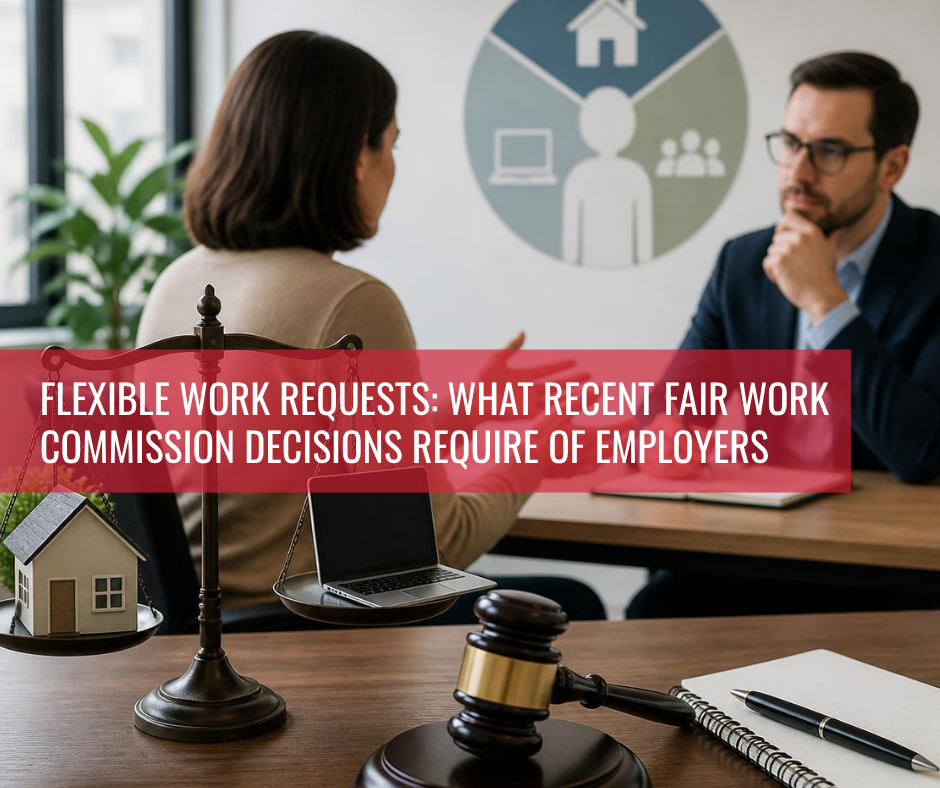
Manager discussing a flexible work request with an employee across a desk, with legal symbols including scales of justice, a gavel, and hybrid work icons representing Australian workplace flexibility and Fair Work compliance.

Flexible Work Requests: What Recent Fair Work Commission Decisions Require of Employers

What’s the real issue?  Since the 2023 changes to the Fair Work Act 2009 (Cth), how you handle a flexible work request now matters as much as whether you say yes or no. Under section 65B, the Fair Work Commission (FWC) can now arbitrate refused requests — and order you to grant one anyway if you did not follow the

Flexible Work Requests: What Recent Fair Work Commission Decisions Require of Employers Read More »

Featured image showing an open office doorway leading to a workplace, symbolising an employee's return to work, injury recovery, workplace reintegration, and employer responsibilities under Australian employment and WHS laws.

Return to Work Under Pressure: Managing Injury, Capacity and Employer Risk in the Australian Workplace

Managing ill and injured employees is one of the highest-risk tasks any Australian employer faces. When a worker is injured or falls ill, several legal regimes switch on at once — and they don’t always agree. Get it right and you protect your people and your organisation. Get it wrong and one termination can trigger multiple claims.  Here’s how to do it —

Return to Work Under Pressure: Managing Injury, Capacity and Employer Risk in the Australian Workplace Read More »

Featured image showing a manager reviewing probation documents with a new employee, representing probation management, performance discussions, and employer obligations under the Fair Work Act.

Probation Done Properly: What Employer Obligations Under the Fair Work Act Really Mean

Probation is not a legal safe zone. Ending employment during probation removes unfair dismissal exposure — but not a general protections claim, a discrimination complaint, or a breach of contract. Getting the fundamentals right keeps you out of trouble.  What’s the real issue?  Employers routinely confuse two very different things:  A contractual probation period — a creature of contract

Probation Done Properly: What Employer Obligations Under the Fair Work Act Really Mean Read More »

Featured image showing legal scales, a shield with people icons, workplace documents, and silhouettes of employees, representing general protections claims and Fair Work Commission case management for Australian employers.

General Protections Claims: What the Fair Work Commission’s New Case Management Means for Australian Employers

The Fair Work Commission has overhauled how general protections claims are run, and the shift favours prepared employers. Representation is decided “on the papers” before conference; out-of-time applications are triaged before you are served; conciliation is a fast 60-minute, resolution-only session; and a new Early Dispute Resolution (EDR) pilot tests informal settlement calls soon after lodgement. The reforms reward preparation

General Protections Claims: What the Fair Work Commission’s New Case Management Means for Australian Employers Read More »

Three business professionals collaborating in a modern office meeting with laptops, documents, and financial reports on the table.

What Employers Need to Know About the FY26/27 Australian Federal Budget (A practical briefing from Harrisons for Australian employers )

The 2026–27 Federal Budget was handed down on 12 May 2026, and while much of the headline commentary focused on tax cuts and cost-of-living relief, there is a lot in this Budget that Australian employers need to be thinking about right now.  This is not a Budget of broad incentives. It is a Budget of

What Employers Need to Know About the FY26/27 Australian Federal Budget (A practical briefing from Harrisons for Australian employers ) Read More »

Scroll to Top