August 2026

Featured image showing a workplace team collaborating, a protective shield, and wellbeing icons representing psychosocial risk management, psychological safety, and WHS compliance in Australian workplaces.

Managing Psychosocial Risks in the Workplace: Why a Policy Alone Won’t Protect You

What’s the real issue?  Having a psychosocial health and safety policy is not the same as managing psychosocial risk and regulators increasingly treat the gap as a breach. The most common mistake we see is treating this as an HR document rather than a WHS obligation owned by senior leadership exactly the “Band-Aid solution” the Model Code of Practice warns against.  A […]

Managing Psychosocial Risks in the Workplace: Why a Policy Alone Won’t Protect You Read More »

Manager discussing a flexible work request with an employee across a desk, with legal symbols including scales of justice, a gavel, and hybrid work icons representing Australian workplace flexibility and Fair Work compliance.

Flexible Work Requests: What Recent Fair Work Commission Decisions Require of Employers

What’s the real issue?  Since the 2023 changes to the Fair Work Act 2009 (Cth), how you handle a flexible work request now matters as much as whether you say yes or no. Under section 65B, the Fair Work Commission (FWC) can now arbitrate refused requests — and order you to grant one anyway if you did not follow the

Flexible Work Requests: What Recent Fair Work Commission Decisions Require of Employers Read More »

Professional working on a laptop with a shadow silhouette and digital security icons representing AI governance, privacy, and employment risks in the workplace.

Shadow AI in the Workplace: How Australian Employers Can Manage the Governance, Privacy and Employment Risks

Shadow AI is the use of artificial intelligence tools by employees for work — without the employer’s knowledge, approval or oversight, usually through public generative AI chatbots opened straight from a browser.  The answer is not a blanket ban, which simply drives use underground. The answer is governance: a clear AI acceptable-use policy, staff training, clear data rules, human

Shadow AI in the Workplace: How Australian Employers Can Manage the Governance, Privacy and Employment Risks Read More »

Featured image showing a balance scale with employee figures, a vacant office chair under a magnifying glass, and redundancy symbols, representing reasonable redeployment assessments during a genuine redundancy process.

Reasonable Redeployment in Genuine Redundancy: Why “No Vacancies” Is No Longer Enough After the High Court’s Helensburgh Decision

When you make a role redundant, can you rely on the fact that there were simply no other jobs going? Not any more.  Following the High Court’s 2025 decision in the Helensburgh Coal matter, “reasonable redeployment” under section 389 of the Fair Work Act now reaches beyond a list of vacant positions — in some cases it extends

Reasonable Redeployment in Genuine Redundancy: Why “No Vacancies” Is No Longer Enough After the High Court’s Helensburgh Decision Read More »

Featured image showing a calculator, financial documents, and payroll calculations, representing annualised salaries, set-off arrangements, payroll compliance, and employee wage entitlements under Australian employment law.

The Salary Trap: What the Coles and Woolworths Decision Means for Annualised Salaries and Set-Off Arrangements

If you pay an annual salary to award-covered staff, the Coles and Woolworths underpayment decision should be on your radar. Paying a generous salary that “washes out” over a year is no longer enough: a set-off must satisfy award entitlements in each pay period — not on average across the year. That point redraws the compliance map for Australian

The Salary Trap: What the Coles and Woolworths Decision Means for Annualised Salaries and Set-Off Arrangements Read More »

Featured image showing an open office doorway leading to a workplace, symbolising an employee's return to work, injury recovery, workplace reintegration, and employer responsibilities under Australian employment and WHS laws.

Return to Work Under Pressure: Managing Injury, Capacity and Employer Risk in the Australian Workplace

Managing ill and injured employees is one of the highest-risk tasks any Australian employer faces. When a worker is injured or falls ill, several legal regimes switch on at once — and they don’t always agree. Get it right and you protect your people and your organisation. Get it wrong and one termination can trigger multiple claims.  Here’s how to do it —

Return to Work Under Pressure: Managing Injury, Capacity and Employer Risk in the Australian Workplace Read More »

Featured image showing a clock and office telephone symbolising the critical first 48 hours after a serious workplace incident, highlighting the urgency of employer response, WHS compliance, and incident management.

The First 48 Hours After a Serious Workplace Incident: An Employer’s Response Plan

When a worker is killed or seriously injured at work, the first 48 hours shape everything that follows — your legal exposure, your standing with the WHS regulator, the wellbeing of your people, and your ability to defend any future prosecution. The best predictor of a good response is having an incident-response plan ready before anything happens. 

The First 48 Hours After a Serious Workplace Incident: An Employer’s Response Plan Read More »

Featured image showing workplace investigation documents, a clipboard checklist, office files, and a pen, representing procedural fairness, workplace investigations, and compliant HR processes.

Workplace Investigations Done Right: How to Protect Your Organisation Through Process, Procedural Fairness and Privilege

A well-run workplace investigation is one of the strongest risk-management tools an Australian employer has. Done properly, it gives you a defensible basis to act on misconduct. Done poorly, the investigation itself becomes the liability — often costing more than the original complaint.  The difference comes down to process: right scope, procedural fairness, privilege considered early, and

Workplace Investigations Done Right: How to Protect Your Organisation Through Process, Procedural Fairness and Privilege Read More »

Featured image showing a manager reviewing probation documents with a new employee, representing probation management, performance discussions, and employer obligations under the Fair Work Act.

Probation Done Properly: What Employer Obligations Under the Fair Work Act Really Mean

Probation is not a legal safe zone. Ending employment during probation removes unfair dismissal exposure — but not a general protections claim, a discrimination complaint, or a breach of contract. Getting the fundamentals right keeps you out of trouble.  What’s the real issue?  Employers routinely confuse two very different things:  A contractual probation period — a creature of contract

Probation Done Properly: What Employer Obligations Under the Fair Work Act Really Mean Read More »

Featured image showing a diverse team of employees collaborating in a workplace meeting, representing employer leadership, workplace respect, and proactive prevention of sexual harassment under Australia's positive duty laws.

The Positive Duty Explained: How Australian Employers Prevent Sexual Harassment at Work

The biggest shift in Australian sexual harassment law is not a new penalty or complaint form. It is a change in who must act, and when.  Under the Sex Discrimination Act 1984 (Cth), employers now carry a positive duty — a proactive, ongoing obligation to take reasonable and proportionate measures to eliminate sexual harassment, sex discrimination, sex-based harassment, hostile work environments and victimisation, so far as possible. 

The Positive Duty Explained: How Australian Employers Prevent Sexual Harassment at Work Read More »

Featured image showing balanced scales with HR, legal, and psychological safety symbols, representing the intersection of employment law, WHS obligations, and psychosocial risk management in Australian workplaces.

When HR Decisions Become WHS Risks: Managing the Intersection Between Psychosocial Safety Law and Employment Law

Performance-manage an underperformer, restructure a team or investigate a bullying complaint, and you are no longer working within employment law alone. That decision now sits inside your work health and safety duty — and a process that is perfectly lawful under the Fair Work Act can still expose you under WHS legislation.  The answer is not to

When HR Decisions Become WHS Risks: Managing the Intersection Between Psychosocial Safety Law and Employment Law Read More »

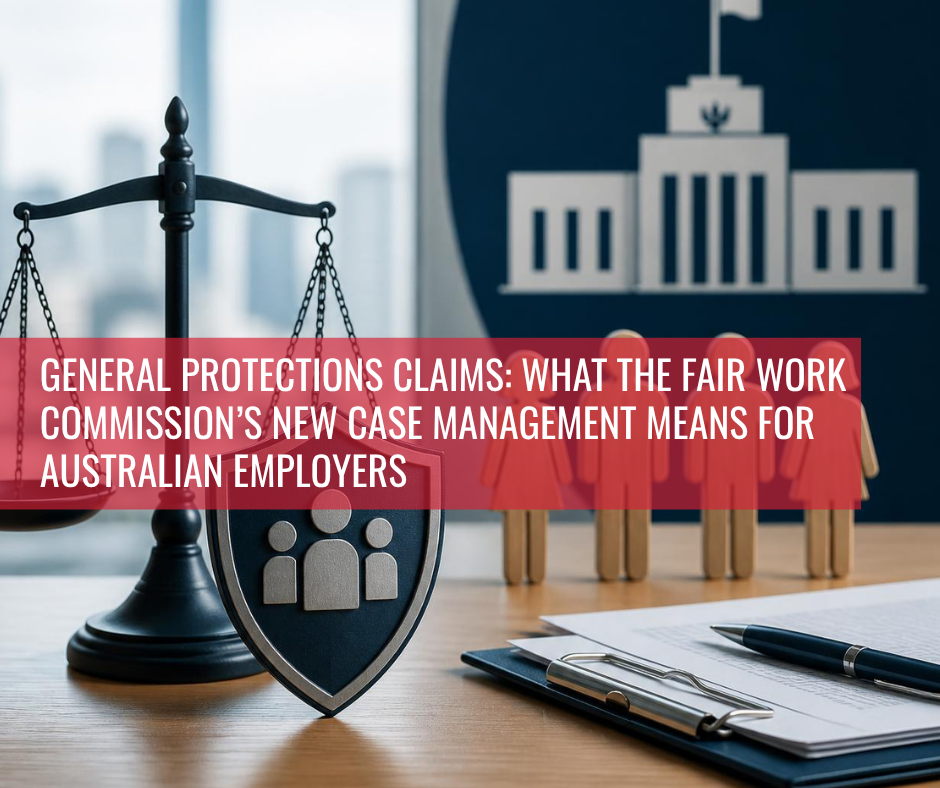
Featured image showing legal scales, a shield with people icons, workplace documents, and silhouettes of employees, representing general protections claims and Fair Work Commission case management for Australian employers.

General Protections Claims: What the Fair Work Commission’s New Case Management Means for Australian Employers

The Fair Work Commission has overhauled how general protections claims are run, and the shift favours prepared employers. Representation is decided “on the papers” before conference; out-of-time applications are triaged before you are served; conciliation is a fast 60-minute, resolution-only session; and a new Early Dispute Resolution (EDR) pilot tests informal settlement calls soon after lodgement. The reforms reward preparation

General Protections Claims: What the Fair Work Commission’s New Case Management Means for Australian Employers Read More »

Scroll to Top