
SME Employers

Featured image showing stacks of employment documents and contracts on a desk, representing the complexities of determining whether a worker is a contractor or employee under Australian workplace laws.

Contractor or Employee? Why One Worker Can Be Both — and What Misclassification Now Costs

“They invoice us. They have an ABN. They’re a contractor.”  That reasoning has never been enough, and in 2026 it is actively dangerous. A single worker can be a contractor at common law, an employee for superannuation purposes, and a deemed employee for payroll tax — all at the same time, under three different tests. 

Contractor or Employee? Why One Worker Can Be Both — and What Misclassification Now Costs Read More »

Featured image showing a calendar highlighting a seven-day period alongside a calculator and money, representing Payday Super, pay-cycle superannuation payments and employer payroll obligations.

Payday Super Is Here: What Employers Must Fix Now That Superannuation Is a Pay-Cycle Obligation

For decades, superannuation was a quarterly problem. You accrued it, you reconciled it, and you paid it within 28 days of the quarter’s end. From 1 July 2026 that model is gone.  Superannuation is now a pay-cycle obligation: contributions must be received by the employee’s fund within seven business days of payday. Miss it — even by a day, even by a small amount — and

Payday Super Is Here: What Employers Must Fix Now That Superannuation Is a Pay-Cycle Obligation Read More »

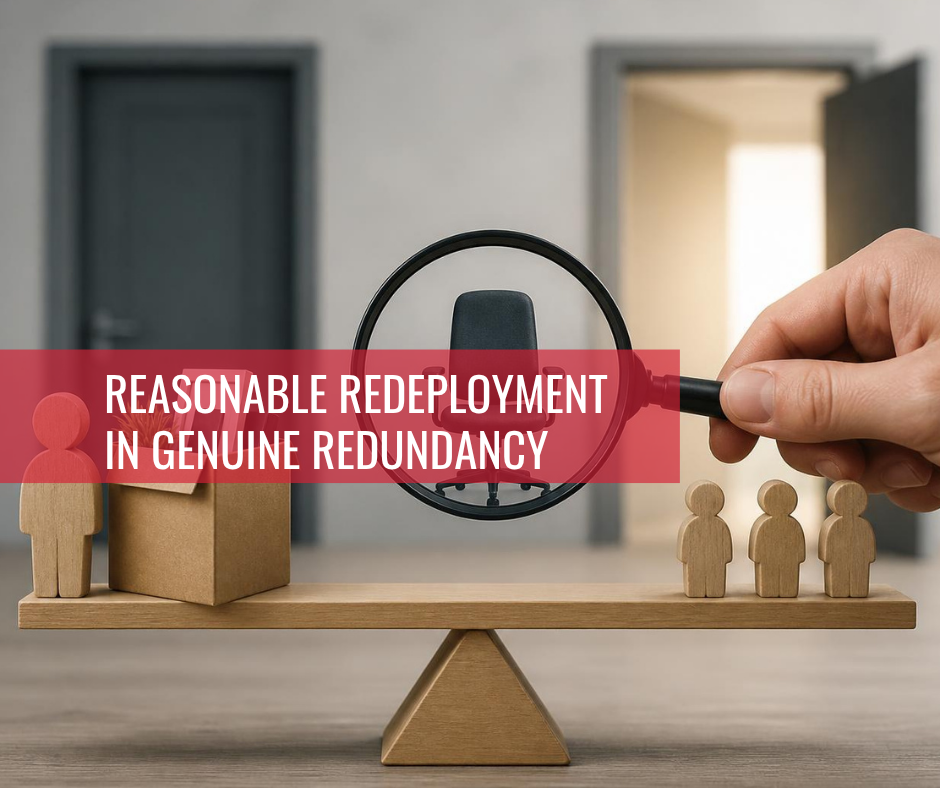
Featured image showing a balance scale with employee figures, a vacant office chair under a magnifying glass, and redundancy symbols, representing reasonable redeployment assessments during a genuine redundancy process.

Reasonable Redeployment in Genuine Redundancy: Why “No Vacancies” Is No Longer Enough After the High Court’s Helensburgh Decision

When you make a role redundant, can you rely on the fact that there were simply no other jobs going? Not any more.  Following the High Court’s 2025 decision in the Helensburgh Coal matter, “reasonable redeployment” under section 389 of the Fair Work Act now reaches beyond a list of vacant positions — in some cases it extends

Reasonable Redeployment in Genuine Redundancy: Why “No Vacancies” Is No Longer Enough After the High Court’s Helensburgh Decision Read More »

Featured image showing a calculator, financial documents, and payroll calculations, representing annualised salaries, set-off arrangements, payroll compliance, and employee wage entitlements under Australian employment law.

The Salary Trap: What the Coles and Woolworths Decision Means for Annualised Salaries and Set-Off Arrangements

If you pay an annual salary to award-covered staff, the Coles and Woolworths underpayment decision should be on your radar. Paying a generous salary that “washes out” over a year is no longer enough: a set-off must satisfy award entitlements in each pay period — not on average across the year. That point redraws the compliance map for Australian

The Salary Trap: What the Coles and Woolworths Decision Means for Annualised Salaries and Set-Off Arrangements Read More »

Featured image showing a clock and office telephone symbolising the critical first 48 hours after a serious workplace incident, highlighting the urgency of employer response, WHS compliance, and incident management.

The First 48 Hours After a Serious Workplace Incident: An Employer’s Response Plan

When a worker is killed or seriously injured at work, the first 48 hours shape everything that follows — your legal exposure, your standing with the WHS regulator, the wellbeing of your people, and your ability to defend any future prosecution. The best predictor of a good response is having an incident-response plan ready before anything happens. 

The First 48 Hours After a Serious Workplace Incident: An Employer’s Response Plan Read More »

Scroll to Top