Fair Work Commission

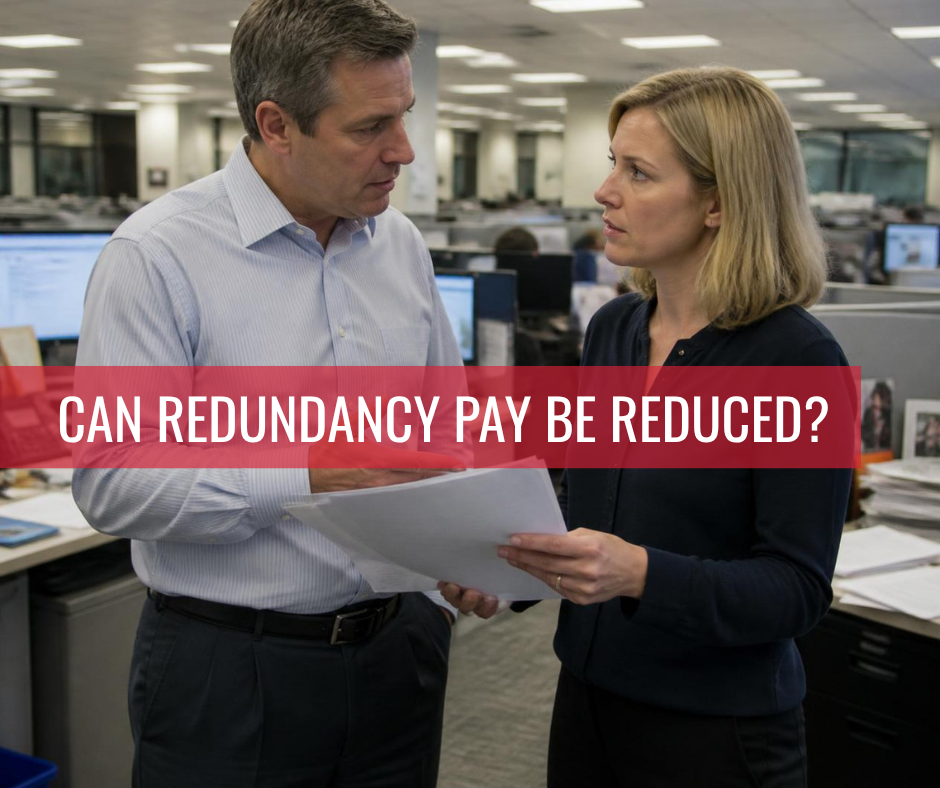
Two colleagues discussing redundancy documents in an office, representing redundancy pay and alternative employment considerations.

Can Redundancy Pay Be Reduced? What “Other Acceptable Employment” Really Means Under Section 120

Most employers know that a genuine redundancy triggers redundancy pay. Far fewer know that the Fair Work Commission can reduce that payment — sometimes to nothing — where the employer has obtained other acceptable employment for the employee.  And far fewer still appreciate the sting in the test: whether the alternative employment is “acceptable” is judged objectively. It does
Can Redundancy Pay Be Reduced? What “Other Acceptable Employment” Really Means Under Section 120 Read More »

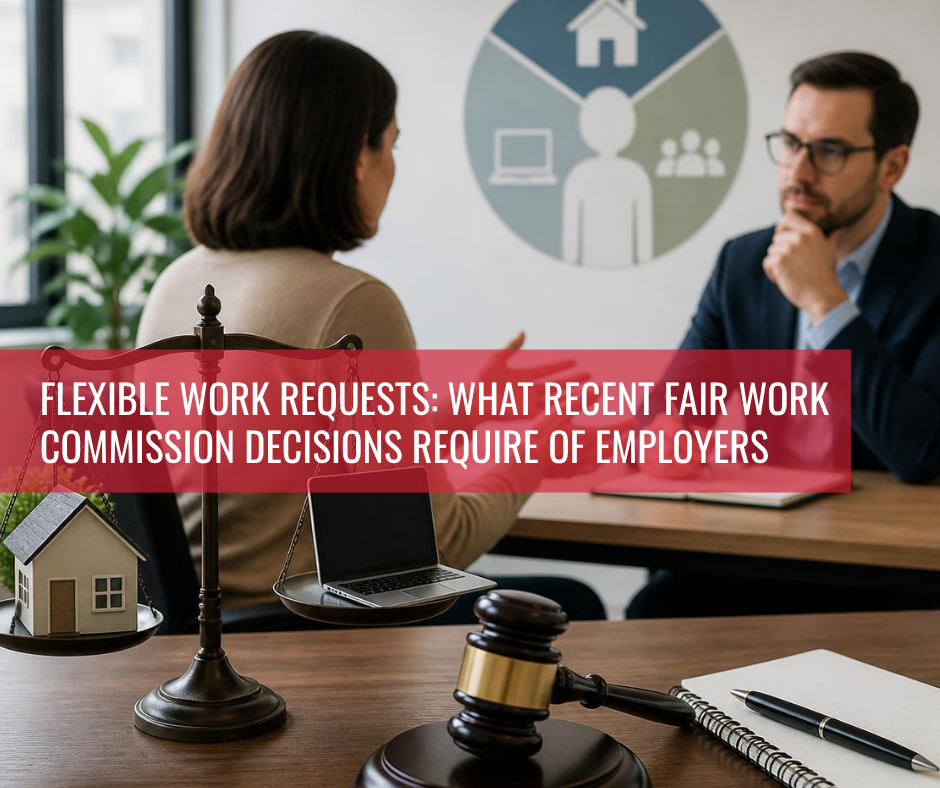
Manager discussing a flexible work request with an employee across a desk, with legal symbols including scales of justice, a gavel, and hybrid work icons representing Australian workplace flexibility and Fair Work compliance.

Flexible Work Requests: What Recent Fair Work Commission Decisions Require of Employers

What’s the real issue?  Since the 2023 changes to the Fair Work Act 2009 (Cth), how you handle a flexible work request now matters as much as whether you say yes or no. Under section 65B, the Fair Work Commission (FWC) can now arbitrate refused requests — and order you to grant one anyway if you did not follow the

Flexible Work Requests: What Recent Fair Work Commission Decisions Require of Employers Read More »

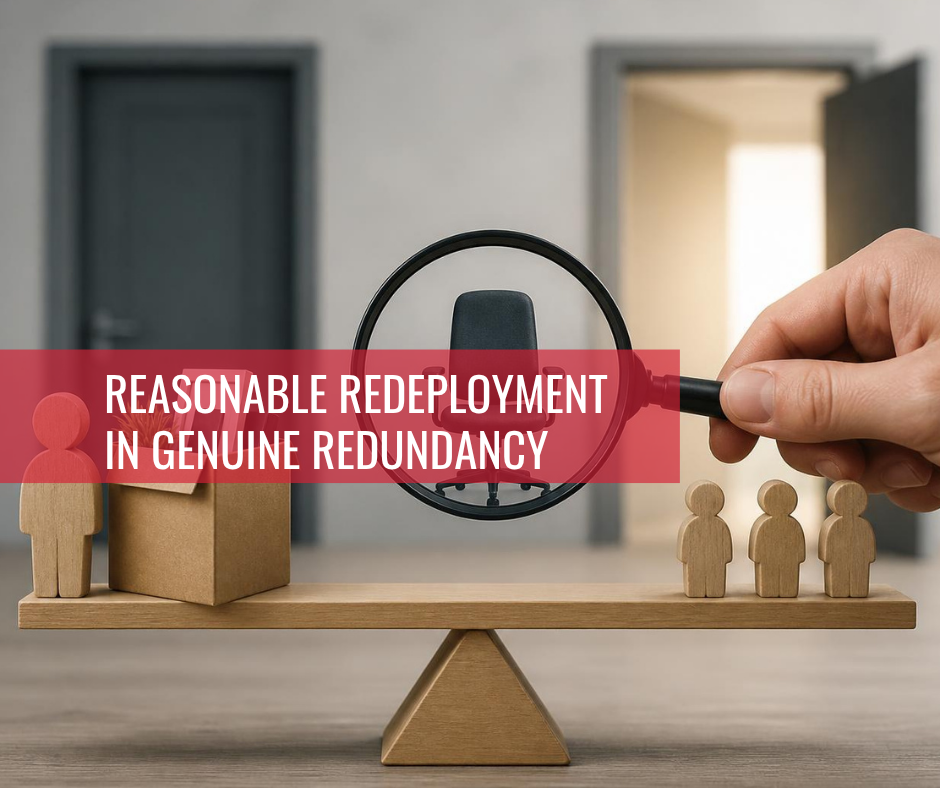
Featured image showing a balance scale with employee figures, a vacant office chair under a magnifying glass, and redundancy symbols, representing reasonable redeployment assessments during a genuine redundancy process.

Reasonable Redeployment in Genuine Redundancy: Why “No Vacancies” Is No Longer Enough After the High Court’s Helensburgh Decision

When you make a role redundant, can you rely on the fact that there were simply no other jobs going? Not any more.  Following the High Court’s 2025 decision in the Helensburgh Coal matter, “reasonable redeployment” under section 389 of the Fair Work Act now reaches beyond a list of vacant positions — in some cases it extends

Reasonable Redeployment in Genuine Redundancy: Why “No Vacancies” Is No Longer Enough After the High Court’s Helensburgh Decision Read More »

Featured image showing workplace investigation documents, a clipboard checklist, office files, and a pen, representing procedural fairness, workplace investigations, and compliant HR processes.

Workplace Investigations Done Right: How to Protect Your Organisation Through Process, Procedural Fairness and Privilege

A well-run workplace investigation is one of the strongest risk-management tools an Australian employer has. Done properly, it gives you a defensible basis to act on misconduct. Done poorly, the investigation itself becomes the liability — often costing more than the original complaint.  The difference comes down to process: right scope, procedural fairness, privilege considered early, and

Workplace Investigations Done Right: How to Protect Your Organisation Through Process, Procedural Fairness and Privilege Read More »

Featured image showing a manager reviewing probation documents with a new employee, representing probation management, performance discussions, and employer obligations under the Fair Work Act.

Probation Done Properly: What Employer Obligations Under the Fair Work Act Really Mean

Probation is not a legal safe zone. Ending employment during probation removes unfair dismissal exposure — but not a general protections claim, a discrimination complaint, or a breach of contract. Getting the fundamentals right keeps you out of trouble.  What’s the real issue?  Employers routinely confuse two very different things:  A contractual probation period — a creature of contract

Probation Done Properly: What Employer Obligations Under the Fair Work Act Really Mean Read More »

Featured image showing a diverse team of employees collaborating in a workplace meeting, representing employer leadership, workplace respect, and proactive prevention of sexual harassment under Australia's positive duty laws.

The Positive Duty Explained: How Australian Employers Prevent Sexual Harassment at Work

The biggest shift in Australian sexual harassment law is not a new penalty or complaint form. It is a change in who must act, and when.  Under the Sex Discrimination Act 1984 (Cth), employers now carry a positive duty — a proactive, ongoing obligation to take reasonable and proportionate measures to eliminate sexual harassment, sex discrimination, sex-based harassment, hostile work environments and victimisation, so far as possible. 

The Positive Duty Explained: How Australian Employers Prevent Sexual Harassment at Work Read More »

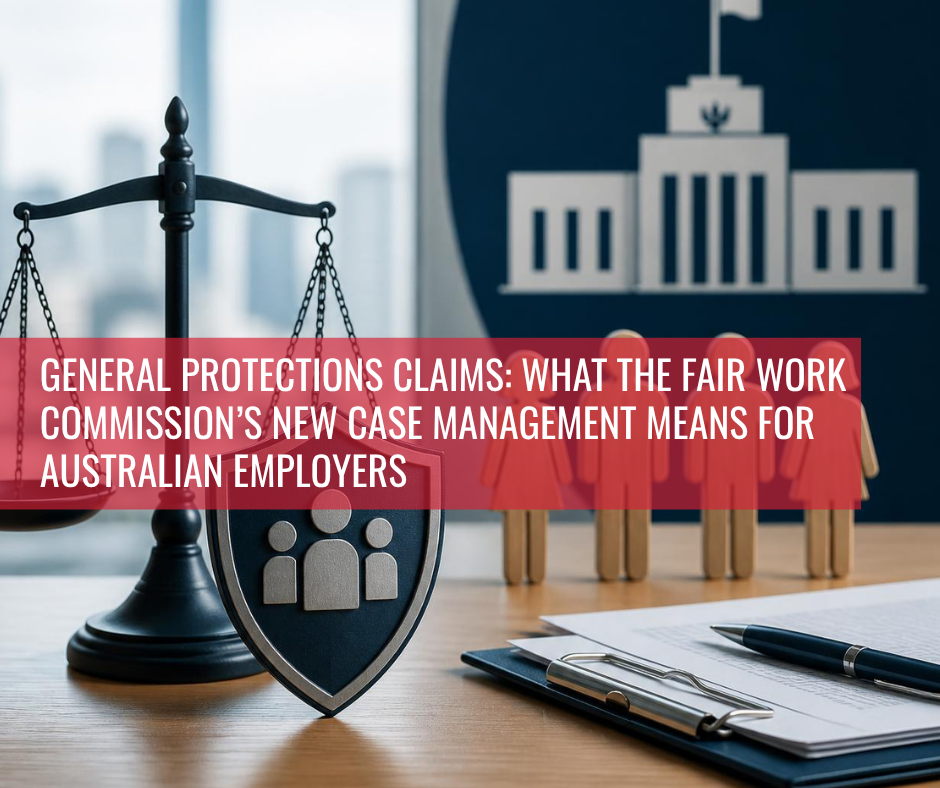
Featured image showing legal scales, a shield with people icons, workplace documents, and silhouettes of employees, representing general protections claims and Fair Work Commission case management for Australian employers.

General Protections Claims: What the Fair Work Commission’s New Case Management Means for Australian Employers

The Fair Work Commission has overhauled how general protections claims are run, and the shift favours prepared employers. Representation is decided “on the papers” before conference; out-of-time applications are triaged before you are served; conciliation is a fast 60-minute, resolution-only session; and a new Early Dispute Resolution (EDR) pilot tests informal settlement calls soon after lodgement. The reforms reward preparation

General Protections Claims: What the Fair Work Commission’s New Case Management Means for Australian Employers Read More »

Two professionals shaking hands in a modern office while discussing employment terms and pay arrangements.

Loaded pay rates: a tempting handshake that can land you in serious trouble

At a franchisor presentation last night, a franchisee asked me a question that I suspect plays out in workplaces across Australia every single day.  A promising candidate negotiates a higher hourly rate. The employer agrees — and to keep things simple, says the rate also covers the tool allowance and annual leave loading. Everyone shakes

Loaded pay rates: a tempting handshake that can land you in serious trouble Read More »

Three business professionals collaborating in a modern office meeting with laptops, documents, and financial reports on the table.

What Employers Need to Know About the FY26/27 Australian Federal Budget (A practical briefing from Harrisons for Australian employers )

The 2026–27 Federal Budget was handed down on 12 May 2026, and while much of the headline commentary focused on tax cuts and cost-of-living relief, there is a lot in this Budget that Australian employers need to be thinking about right now.  This is not a Budget of broad incentives. It is a Budget of

What Employers Need to Know About the FY26/27 Australian Federal Budget (A practical briefing from Harrisons for Australian employers ) Read More »

Scroll to Top